

electrocardiography


 1
6.1
- noun
- /ˌɛlɛkˌtroʊkɑrdioʊˈɡræfɪ/
- Specialized
- In the majority of cases, clinical evidence of hypocalcemia is absent; therefore, high-risk patients must be evaluated by electrocardiography for prolonged QT interval and arrhythmias and placed on cardiac monitoring (Figure 2) (14).
- electrocardiography (ECG)
Examples
-
Keywords: Atrial fibrillation, Electrocardiography, ambulatory; Stroke #
Academic text (2014) -
HRMs have been shown to be as accurate as an electrocardiography (Engstrom, Ottosson, Wohlfart, Grundstrom, & Wisen, 2012).
Academic text (2015) -
Electrocardiography gives a normal reading.
Academic text (2010) -
The initial clinical assessment included a general physical and neurological examination, medical history, electrocardiography (ECG), and details of the qualifying event.
Academic text (1991) -
Electrocardiography (ECG) is now commonly available in GP practices, and a resting ECG should be recorded as soon as possible.
Academic text (2010) -
Serologic tests to rule out other granulomatous diseases are routinely used, as are specific end-organ diagnostic modalities such as pulmonary function tests and electrocardiography.
Academic text (2008) -
The monitoring included electrocardiography with rhythm-control printout and measurement of left-ventricular ejection fraction by echocardiography or radionuclide scan.
Academic text (2002) -
Twelve-lead electrocardiography performed in the postanesthesia recovery room showed ST changes in the inferolateral leads; myocardial infarction was ruled out by serial creatine kinase measurements.
Academic text (1999) -
Electrocardiography is often used to detect electrocardiography problems early during routine check-ups.
-
The doctor ordered electrocardiography to assess the patient's heart rhythm after he experienced chest pain.
Synonyms
 1
5.7
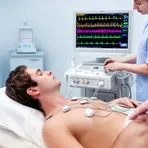
A test that records the heart's movement and electrical signals to check for problems
Surface Forms
Morphology
electrocardiography = electrocardiograph (semi-transparent) = electro + cardio + graph + y
The word is a regular technical derivation from 'electrocardiograph' with '-y' forming the process or field, but the full medical term is specialized.
Etymology
The word electrocardiography breaks into electro- ('electric'), cardio- ('heart') and -graphy ('recording'), so it literally means 'recording the heart's electric signals', which is exactly what the test does.