
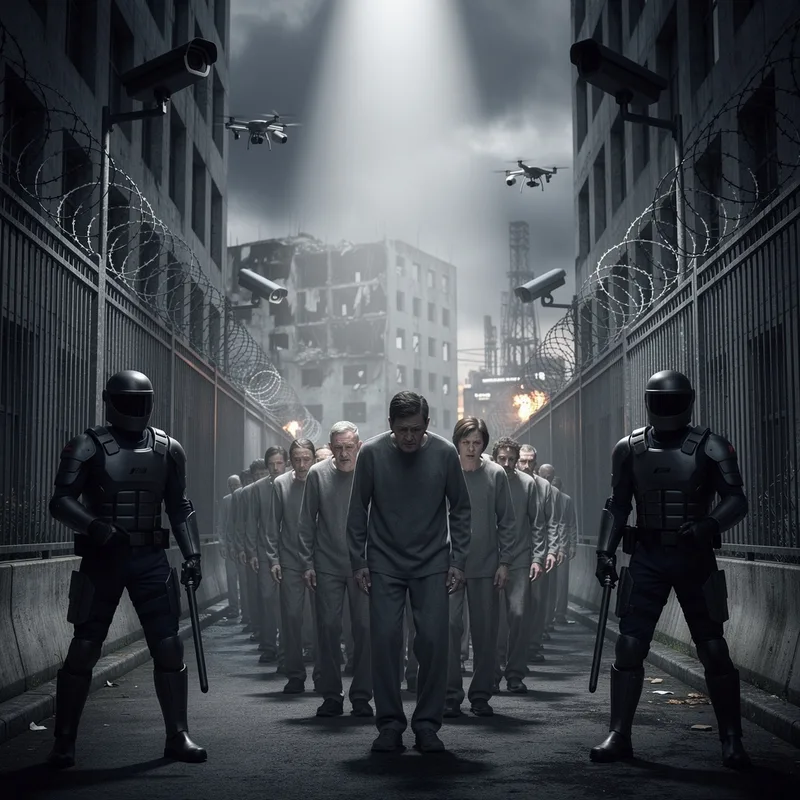
dystopic
 1
8.8
1
8.8

- adjective
- /dɪsˈtoʊpɪk/
- Literature
- Many critics hailed the film as a brilliant portrayal of a dystopic world plagued by oppression and despair.
- dystopic world
- dystopic future
Loading YouTube…
Watch on YouTubeAnd we're in, you know, some version of that dystopic reality that's unfolding in real time amongst us.
- And we're in, you know, some version of that dystopic reality that's unfolding in real time amongst us.
Examples
-
It features videos from Ms. Streep and Sarah Silverman, a near-future dystopic version of the Daily Planet, and more.
Blog text (16) -
The movie depicted a dystopic society where citizens lived in constant fear of surveillance.
-
This went to a very dark, dystopic level.
-
Here in America, you could be living a utopian or dystopic life depending on your status and circumstances.
Blog text (32) -
Should we find a way to manage the risks and avoid dystopic outcomes, our far future looks astonishingly bright.
Blog text (17) -
It's a dystopic juxtaposition: the desperate old paired with the horrible new.
Blog text (8) -
And we're in, you know, some version of that dystopic reality that's unfolding in real time amongst us.
-
The exodus of more and more life activities from physical into digital felt not like "progress," but rather as if a dystopic sci-fi plot was taking over the world in real time.
Blog text (9) -
Subsequently, he called for technological relinquishment—a kind of neo-Luddism intended to prevent dystopic outcomes and outright human extinction.
Blog text (17) -
Within postmodernism, perhaps the only alternative to the games of mirrors of metafiction is cyberpunk, a blend of science fiction and dystopic anticipation spiked with themes of contemporary counterculture.
Academic text (1995)
Synonyms
 14
8.3
14
8.3
A society, often in the future, where people suffer under cruel rule
 13
9.9
13
9.9
About a society with constant spying, heavy propaganda and no personal freedom
Antonyms
How Dystopian

Surface Forms
Morphology
dystopic = dystopia (transparent) = dys + top + ic
The adjective 'dystopic' is clearly derived from the noun 'dystopia' with the addition of the suffix '-ic'.
Etymology
Dystopic comes from Greek parts dys- 'bad' and topos 'place', and is the opposite of utopia. A helpful way to remember it is to think of a 'bad place' or future world where people suffer, which is why dystopic describes cruel or unfair societies.