

dissociation energy
- noun
- /ˌdɪsəʊsiˈeɪʃən ˈɛnədʒi/
- Specialized
 :
energía de disociación
:
energía de disociación
- The dissociation energy required to separate the atoms in water is lower than that of methane.
- bond dissociation energies
Examples
-
That's because the dissociation energy of the oxygen molecule is much less than its ionization energy.
Academic text (2006) -
ONIOM methods can be applied to virtually any chemical problem, but one of the first areas that has been covered in great detail is the calculation of bond dissociation energies (BDEs).
Academic text (2001) -
Instead of talking about an energy, a dissociation energy, a bond energy, we're going to talk about a bond enthalpy.
-
OK, so this is his his table of molecular bond dissociation energies for losing H from something.
-
So now we've got the dissociation energy for the reactants, right?
-
These are relative bond dissociation energies taking zero to be methyl, right?
-
Bond dissociation energies
Academic text (2001) -
In addition to bond dissociation energies, Diels-Alder reactions have been studied extensively with the ONIOM method.
Academic text (2001) -
This is similar to the IMOMO studies of bond dissociation energies, in which we observed that results are often inadequate when the HF level is employed for a layer too close to the reaction center.
Academic text (2001) -
The dissociation energies of sets of larger molecules were calculated by Froese 54, 55 and Vreven (n1) 56.
Academic text (2001)
Synonyms


 1
7.4
1
7.4
Energy needed to separate the parts of an atom, nucleus, or molecule

Energy needed to break molecules into smaller parts in a hot gas or liquid
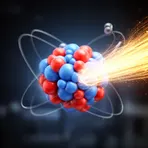
The amount of energy needed to remove a particle, for example an electron or neutron, from an atom
Surface Forms
Morphology
The phrase is compositionally built from 'dissociation' (splitting a molecule) and 'energy' (amount of power), so its meaning — the energy required to cause dissociation — is directly derivable from the constituents. Although it is a technical chemistry term, the semantic relation is transparent and follows standard noun–noun modification patterns found across languages, making it accessible to learners who know both words.
Etymology
Dissociation energy comes from a simple image: dissociation means splitting something apart and energy is the power needed to do it. Imagine two atoms holding hands — the stronger the hold, the more push you need, so dissociation energy is the amount of energy needed 'to break' a molecule into separate atoms.