
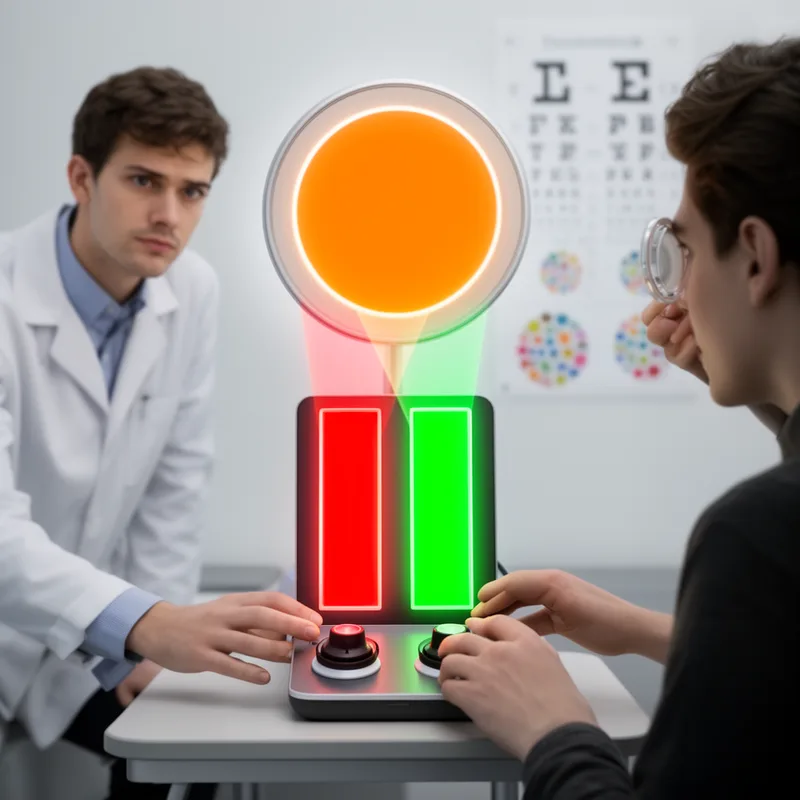
dichromia
- noun
- /daɪˈkroʊmiə/
- Specialized
- Diagnosing dichromia often involves testing the patient's ability to distinguish between certain hues.
Examples
-
Individuals with dichromia often have difficulty distinguishing between shades of red and green.
-
People with dichromia can match all colors using only two wavelengths of light.
-
Researchers study the genetic causes of dichromia to better understand color vision disorders.
-
He was diagnosed with dichromia at a young age.
-
Can dichromia affect someone's daily life?
-
A common symptom of dichromia is the inability to see certain colors as vividly as others.
-
When someone has dichromia, they may only need two colors to replicate the full spectrum of hues.
Synonyms


 1
3.7
1
3.7
Not able to tell some colors, often red and green

A condition where a person sees colors with only two types of cells, making red and green hard to tell

A condition in which a person sees colors using only two kinds of light instead of three

A vision condition where a person can match any colour using only two colours of light instead of three

A condition where a person sees fewer colors and often confuses red and green
A problem where a person cannot tell some colors apart, often red and green
Antonyms
- Specialized
Seeing many colors normally because the eyes have three kinds of color cells
How Complete

Surface Forms
Morphology
dichromia = chromia (semi-transparent) = di + chrom + ia
The parts (di- 'two' + chromia 'color condition') give the general sense 'two-color condition', but the term is technical and uses Greek combining forms that many learners may not know.
Etymology
Dichromia comes from Greek parts di- meaning 'two' and chroma meaning 'color'. So, dichromia describes a condition where a person has only two working color types instead of three, which is why they can match all colors using only two kinds of light.