

cyclotron
 3
9.9
3
9.9

- noun
- /ˈsaɪkləˌtrɒn/
- Specialized
- Recent additions to the Exhibit Hall website include "Lawrence and the Cyclotron" and "Selected Papers of Great American Physicists."
- cyclotron frequency
- cyclotron orbit
- cyclotron radius
Loading YouTube…
Watch on YouTubeThe biggest hurdle for me is that I don't like the blinky light pattern in the cyclotron.
- The biggest hurdle for me is that I don't like the blinky light pattern in the cyclotron.
Examples
-
PHOTO (BLACK & WHITE): Ernest Lawrence (1901-1958) developed the cyclotron, the first particle accelerator to achieve high energies.
Academic text (2004) -
The positron-emitting tracer is made by irradiating an element with protons from a dedicated local cyclotron.
Academic text (2012) -
How on earth did you build such a small cyclotron?
-
The Harvard guys, they say the building's too small for the cyclotron.
-
While this is going, I want to point out the animation on the spinning cyclotron is really nice.
-
Therefore, it seems useless to build cyclotrons of larger proportions than the existing ones.
Academic text (1993) -
The gas-filled separator at the Berkeley 88-inch cyclotron is used to search for superheavy nuclei.
Academic text (2002) -
The ion beam is accelerated in LBNL's 88-inch cyclotron to 4.5 MeV per nucleon.
Academic text (1995) -
Scientists use a cyclotron to accelerate particles for experiments in high-energy physics.
-
The cyclotron can generate a beam of particles used to study atomic nuclei.
Synonyms
 48
7.1
48
7.1
A machine that makes particles move faster for scientific study
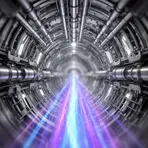 11
5.5
11
5.5
A machine that makes tiny charged particles move faster for science or medicine
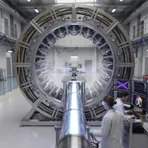 2
9.9
2
9.9
A large machine that makes tiny particles move very fast to study materials
 2
6.0
2
6.0
A large machine scientists use to make tiny particles move very fast and hit each other


 1
9.9
1
9.9
A large machine that speeds up protons for physics experiments

A machine that makes charged particles go almost as fast as light by changing the frequency of electric pulses
How Powerful
- Specialized
12
9.1

- Specialized
2
9.9
- Specialized
3
9.9
- Specialized
11
5.5
- Specialized
1
7.0
- Specialized
Surface Forms
Morphology
Etymology
The word cyclotron comes from Greek parts cyclo- ('circle') and -tron ('instrument' or 'device'). Think of a bicycle going round and round: a cyclotron makes tiny particles move in circles, so the name literally means a 'circle machine'.