

cranial orbit
- noun
- /ˈkreɪniəl ˈɔrbɪt/
- Specialized
- The CT scan revealed a small tumor within the patient's left cranial orbit.
Examples
-
The surgeon carefully examined the cranial orbit for any signs of fracture after the accident.
-
In some animals, the cranial orbit is positioned differently to give them a wider field of vision.
-
The cranial orbit houses the eyeball.
-
Many animals have larger cranial orbits than humans.
-
The CT scan revealed a small tumor within the patient's left cranial orbit.
-
The surgeon carefully examined the cranial orbit for any signs of fracture after the accident.
-
In some animals, the cranial orbit is positioned differently to give them a wider field of vision.
Synonyms
 14
3.5
14
3.5

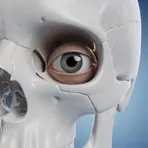
A hollow space in the skull that holds the eyeball
 5
8.1
5
8.1
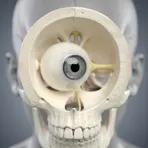
A bony hollow in the skull that holds and protects the eye

 1
6.8
1
6.8
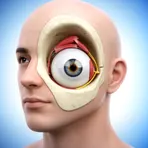
A bony socket in the skull that holds and protects the eye
Surface Forms
Morphology
The meaning 'the bony cavity in the skull that contains the eyeball' is directly and predictably derived from 'cranial' (relating to the skull) modifying 'orbit' (a bony cavity that holds the eyeball). This is a transparent, compositional noun–noun/adj–noun combination following standard English and cross‑linguistic medical naming patterns, so a B1 learner who knows both constituents would understand it.
Etymology
Cranial orbit gives a clear image: cranial means 'skull' and orbit means a round space, so together they name the round area in the skull where the eye sits. So, cranial orbit means the bony cavity that 'holds and protects the eyeball'.