
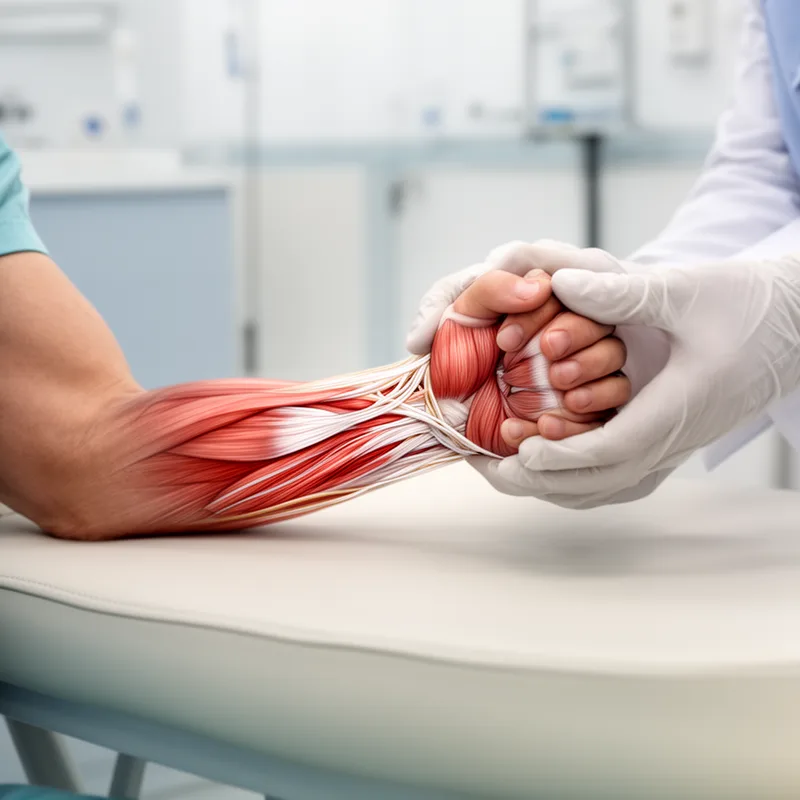
contracture
 1
9.9

- noun
- /kənˈtræktʃər/
- Specialized
- After the injury healed, he developed a contracture in his knee, making it difficult to walk normally.
- capsular contracture
- joint contracture
- flexion contracture
Examples
-
There was fixed flexion contracture of the proximal interphalangeal joint.
Academic text (2012) -
There were no cases of implant migration, implant exposure, or early capsular contracture.
Academic text (2011) -
And you can see, you know, these sort of sort of lines here are contracture lines from the scar formation.
-
The degree of spasticity or joint contracture is noted.
Academic text (2001) -
The Thomas test is performed to assess whether a patient has a flexion contracture of their hip.
Academic text (2010) -
The foot is stiff, with contractures of both the dorsiflexors and plantarflexors.
Academic text (2005) -
Large numbers of patients have presented to plastic surgeons over the years with capsular contracture, breast swelling, and pain.
Academic text (2015) -
However, post-reconstruction radiation increases complications such as contracture and necrosis (3, 4).
Academic text (2012) -
Nasal examination revealed a foreshortening of the columella secondary to fibrosis with contracture (figure 3).
Academic text (2001) -
Reconstructive surgery is often required for Volkmann's contracture, a limb deformity resulting from unrelieved compartment syndrome.
Academic text (2004)
Antonyms


Surface Forms
Morphology
Etymology
Contracture comes from parts that mean 'together' and 'pull': con- means 'together' and tract means 'pull', the same root in contract and contraction. So a contracture is when a muscle or joint is 'pulled together' and stays tight, which is why it causes stiffness and limits movement.