
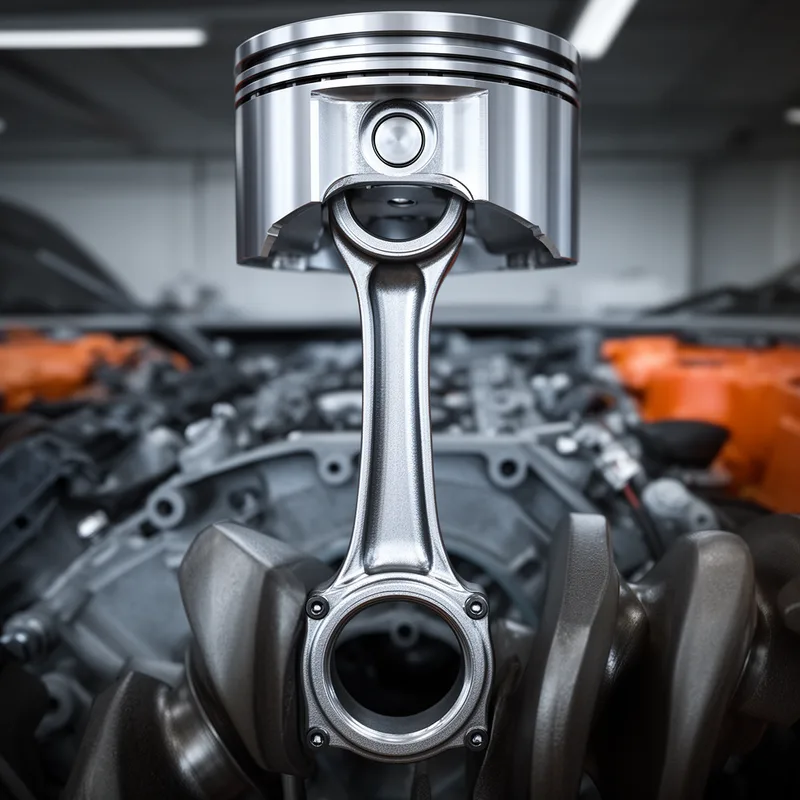
connecting rod
 1
6.3
1
6.3

- noun
- /kəˈnɛktɪŋ rɒd/
- Specialized
- A well-designed connecting rod is crucial for the efficient operation of an internal combustion engine.
- connecting rod and crankshaft
- connecting rod and piston
- steel connecting rod
Examples
-
The connecting rod must be the proper length so that it does not strike the sides of the cylinder.
Academic text (2007) -
The connecting rod has been fully analyzed as a model, along with all the bearings.
Academic text (1996) -
Students will discover that, besides moving to the left and the right, the end of the connecting rod must also be able to move up and down with the throw of the crankshaft.
Academic text (2007) -
The connecting rods went into reverse and rose and fell again as the locomotive, on battery power, backed away in defeat.
Fiction book (2001) -
Watt would later create the now-familiar connecting rod and crankshaft, which were ultimately applied to both engines.
Academic text (2003) -
The connecting rod connects the crankshaft to the piston, allowing the engine to produce power.
-
When the mechanic replaced the broken connecting rod, the engine began to run smoothly again.
Synonyms


 1
4.8
1
4.8
A metal rod that connects a piston to other parts and moves with it
Surface Forms
Morphology
The compound is compositionally transparent: 'connecting' (joining) modifies 'rod' (a long straight piece), so the phrase literally denotes a rod that connects two parts. Although it is a technical engineering term, its meaning follows directly from the constituents and would be inferable to a B1 learner who knows 'connect' and 'rod'.
Etymology
Connecting rod names the metal bar in an engine that links a turning wheel called a crank to a moving piston. Think of it as a short arm on the wheel that pulls and pushes the piston as the wheel turns; connecting means joining and rod means a bar, so the name shows it 'connects' parts and sends motion.