
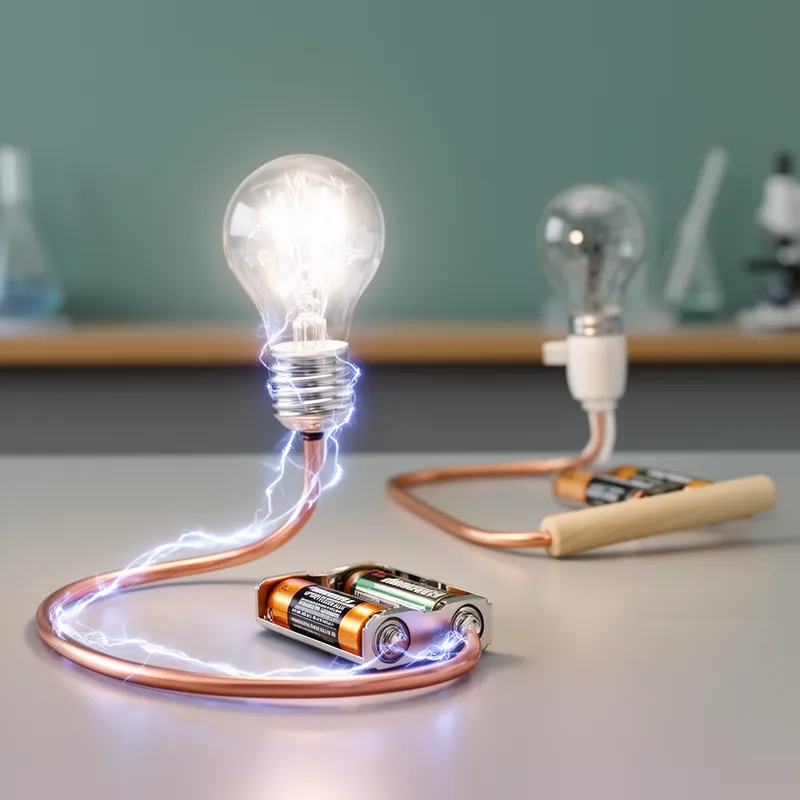
to conduct electricity
 3
3.6
3
3.6

- phrasal verb
- /kənˈdʌkt ɪˈlɛktrɪsɪti/
- Specialized
 :
conducir electricidad
:
conducir electricidad
- Copper wires are commonly used in homes to conduct electricity safely to power devices.
- metals conduct electricity
- Copper wires conduct electricity
- water conducts electricity
It's simple because the same thing when you drink water, water conducts electricity.
- It's simple because the same thing when you drink water, water conducts electricity.
Examples
-
Such applications require materials that conduct electricity very well but conduct heat very poorly.
Blog text (33) -
If you've experienced flooding, steer clear of wet areas in your home as water conducts electricity.
Blog text (18) -
Whether a material conducts electricity without losses is not least a question of the right temperature.
Blog text (17) -
Avoid any puddles or standing water, which can conduct electricity.
Blog text (13) -
The two materials used in this experiment have very similar properties, Luckyanova says, and conduct electricity very well.
Blog text (33) -
At this point, the CNT ink clings to the cotton readily, and the now prepared piece of cotton is able to conduct electricity.
Academic text (2011) -
Meanwhile, objects that conduct electricity about as well as your finger, like banana peels and certain processed meats, can all activate the screen.
-
For this application, carbon fibers conduct electricity too well (although their conductivity depends on the fiber type - see figure 3).
Academic text (1999) -
Copper wires conduct electricity with about 40 percent less resistance than traditional aluminum wires, leading to faster microprocessors, and are less vulnerable to electromigration, which ultimately induces wiring failures.
Academic text (1998) -
Superconductivity is itself a phenomenon that violates the trained intuition of physicists: at sufficiently low temperatures, many metals can conduct electricity without any resistance at all, while simultaneously expelling completely any applied magnetic field.
Academic text (1994)
Synonyms
 18
5.1
18
5.1
To allow heat or electricity to pass through something
Antonyms
 32
4.3
32
4.3
Cover something with material that stops heat, cold, or sound from passing through
How Conductive
- Specialized
4
8.2
 84
3.9
84
3.9
- Specialized
3
3.6
61
3.0
32
4.3
Surface Forms
Morphology
The meaning 'to allow electric current to flow through' is directly and transparently derived from combining 'conduct' (to let heat, electricity, or sound pass through) with 'electricity' (electric energy). This literal verb‑noun composition is common in everyday and technical English and has clear parallels in other languages, so a B1 learner who knows both constituents would readily understand it.
Etymology
Conduct electricity comes from the simple image of a path that conducts electricity, like a pipe carrying water or a wire carrying power. So it means 'to allow electric current to flow'.