
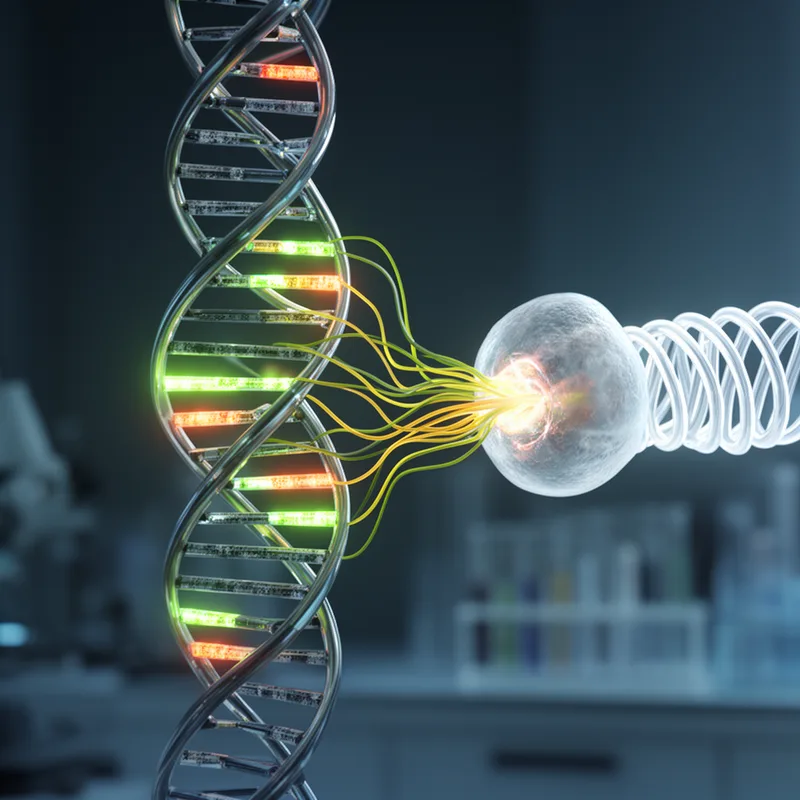
complementary DNA
- noun
- /ˌkɒmplɪˈmɛntəri diːˈɛnˈeɪ/
- Specialized
- Researchers use complementary DNA to study gene expression in various diseases.
- complementary DNA (cDNA)
Examples
-
A library composed of cDNA (complementary DNA) derived from all the mRNA expressed in a specific tissue or cell at a specific time: cDNA microarrays.
Academic text (2008) -
OK, So I'm going to tell you how to make complementary DNA and I'll go through a series of steps.
-
Complementary DNA libraries and expressed sequence tags.
Academic text (2008) -
So the base pairing is associated with complementary DNA strands.
-
Complementary DNA microarrays can allow the identification of previously unknown genes and pathways whose expression correlates with a specific phenotype.
Academic text (2008) -
The scientist synthesized complementary DNA from the mRNA found in cancer cells.
-
By analyzing complementary DNA, they were able to identify the genes responsible for the traits.
Synonyms
 2
8.4
2
8.4

A DNA copy made from messenger RNA by a special enzyme
Surface Forms
Morphology
The adjective 'complementary' conveys matching or corresponding and combined with 'DNA' a learner could plausibly infer 'DNA that corresponds to or pairs with another sequence', so a basic sense is accessible from the parts. However, the precise, technical meaning—single-stranded DNA synthesized from mRNA by reverse transcriptase and used in molecular biology—is specialized and not predictable from everyday senses of the words, making the expression only partially transparent.
Etymology
Complementary DNA comes from the idea that the new DNA is made to 'complement' or match a strand of messenger RNA. Scientists copy the RNA into DNA so it fits like a mirror or a puzzle piece, and that's why complementary DNA means DNA made to match RNA and is used to study which genes are active.