
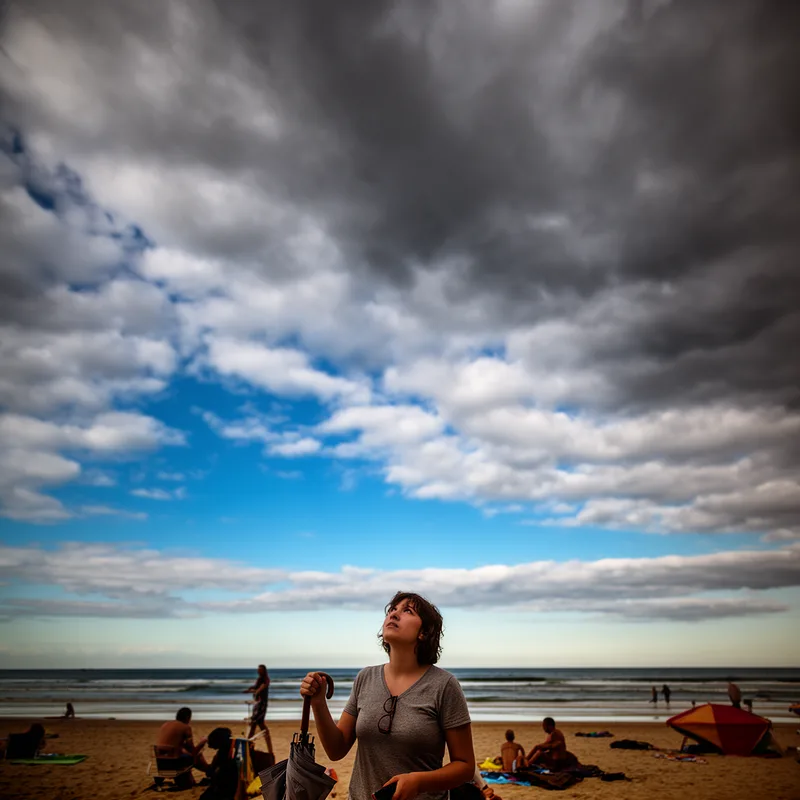
to cloud up
 1
3.2
1
3.2

- phrasal verb
- /klaʊd ʌp/
- The moon will be a crescent, and likely not in the sky when the shower peaks, so viewing will be good if watchers can get away from light pollution in cities, and as long as the weather cooperates and doesn't cloud up.
- the sky clouded up
Examples
-
Thunderdunder clouds up ahead and ljust said rain check.
-
Skies will cloud up a bit more, but not entirely.
Blog text (34) -
Probably all those clouds up there are the reason.
Fiction book (1998) -
The skies to the west started to cloud up.
Fiction book (1992) -
It has clouded up a bit.
Fiction book (1990) -
Janie sighed and watched her own breath cloud up the window.
Fiction book (1999) -
The sky had clouded up while they'd been inside; they had the bike paths under the trees mostly to themselves.
Fiction book (2002) -
Outside, the sky had clouded up and a drizzle looked imminent.
Fiction book (1994) -
The target's clouded up.
Fiction book (1990) -
The sky began to cloud up as the sun set, signaling a change in the weather.
Synonyms
 56
4.4
56
4.4
To make something less clear or bright by covering it


 1
3.4
1
3.4
The sky becomes covered with clouds and looks less bright
Sky becomes covered with clouds and looks gray
Antonyms


How Cloudy

Surface Forms
Morphology
The meaning 'to become covered with clouds' is transparently derived from 'cloud' (to cover or obscure) combined with the particle 'up' which signals an increase or change of state; together they naturally convey 'becoming cloudy'. This verb+particle composition is a common, compositional pattern in English and would be understandable to a B1 learner who knows both constituents.
Etymology
Cloud up comes from the simple image of the sky filling with clouds, where the parts cloud and up show clouds moving in to cover the sky. So, when the sky 'clouds up' it means 'become cloudy'.