
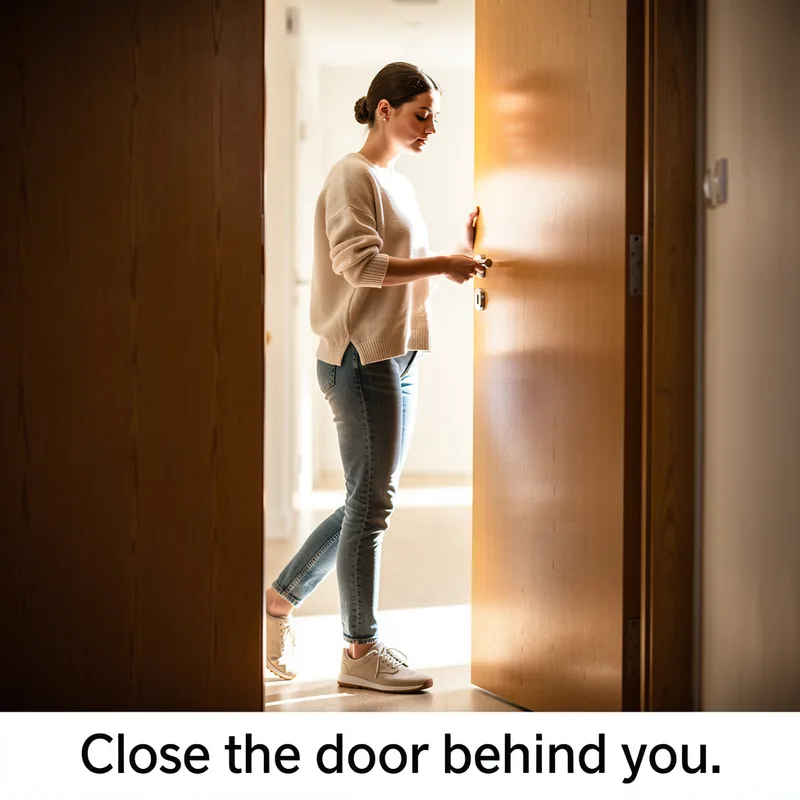
to close the door behind you
 12
1.0
12
1.0

- phrasal verb
- Close the door behind you, please.
- close the door behind you
- carefully close the door behind you
- gently close the door behind you
Examples
-
Take Magic Downey back to the locker room and close the door behind you.
-
Close the door behind you.
-
You close the door behind you.
-
And close the door behind you.
-
Just close the door behind you.
-
Now, close the door behind you.
-
On the way out, close the door behind you, 'cause we wanna talk in private.
-
Close the door behind you.
-
Close the door behind you.
-
Please remember to close the door behind you when you leave the room.
Synonyms

Antonyms

Surface Forms
Morphology
close + the + door + behind + you
The meaning 'to shut the door after you have gone through' is directly and transparently composed from 'close' (to shut) + 'door' (the entry barrier) + 'behind you' (in your rear/after you), so the instruction is immediately derivable from the parts. This is a common, cross-linguistic spatial/compositional pattern and follows standard English verb + object + adverbial structure, so a B1 learner who knows the constituent words will readily understand it.
Etymology
Close the door behind you comes from the simple image of leaving a room and pushing the door shut so it is closed behind you. So, it means 'to shut the door after you have gone', for example to keep out the cold, stop noise, or prevent a pet from getting out.