

to clear off
 8
3.0
8
3.0

- phrasal verb
- /klɪr ɔf/
- I gather up the dinner, clear off the picnic table, and toss the garbage into the can.
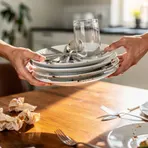
- clear off the table
- clear off the desk
- clear off the dishes
Loading YouTube…
Watch on YouTubeThere was a barbed wire fence and they they had cleared off some of the land and chop the trees down.
- There was a barbed wire fence and they they had cleared off some of the land and chop the trees down.
- I feel like I need to clear all of my handbags out for these.
Examples
-
I'll clear off a space where you can just lie down until the storm passes, okay?
-
Then let's clear this off the table and get everybody focused on the crime bill.
Fiction book (1995) -
You and you, clear off the table.
-
Come on, come on, clear off the street.
-
We are going to clear this off and move our computer onto the desk.
-
Let's clear off the desk first.
-
Hey, Anthony, I'm gonna need you to clear off this contract.
-
Now clear all this stuff off the porch before I call the marshal.
-
Dignan clears everything off the desk with one quick sweep of the arm.
Fiction book (1996) -
Please clear off the desk so we can start the project.
Synonyms
 ∞
1.5
∞
1.5
To remove people or things from a place
 333
2.7
333
2.7
To finish dealing with things and put them in order
 260
1.0
260
1.0
To empty something completely
 179
1.0
179
1.0
To remove everything from a container or place
 28
2.0
28
2.0
To remove something from a surface by moving a cloth over it, like tears or dirt
 20
1.0
20
1.0
Remove dirt or marks from a surface by rubbing with a cloth
 10
1.8
10
1.8
To take things away from a place to make it tidy


 1
1.0
1
1.0
To remove dirt or mud from a surface
Antonyms

How Empty

Surface Forms
Morphology
The meaning is directly built from 'clear' (to remove) plus the particle 'off' (indicating removal from a surface), so the combined sense 'remove things from a surface so it becomes empty or clean' is compositionally predictable. This verb+particle pattern is common in English and mirrored in other languages, so a B1 learner who knows both words would readily infer the MWE's meaning.
Etymology
Clear off comes from the simple image of taking things away from a surface: clear means to make empty and off means move away from it. Imagine pushing plates off a table so the top is empty; that's why it means 'to remove things from a surface so it becomes empty or clean'.