
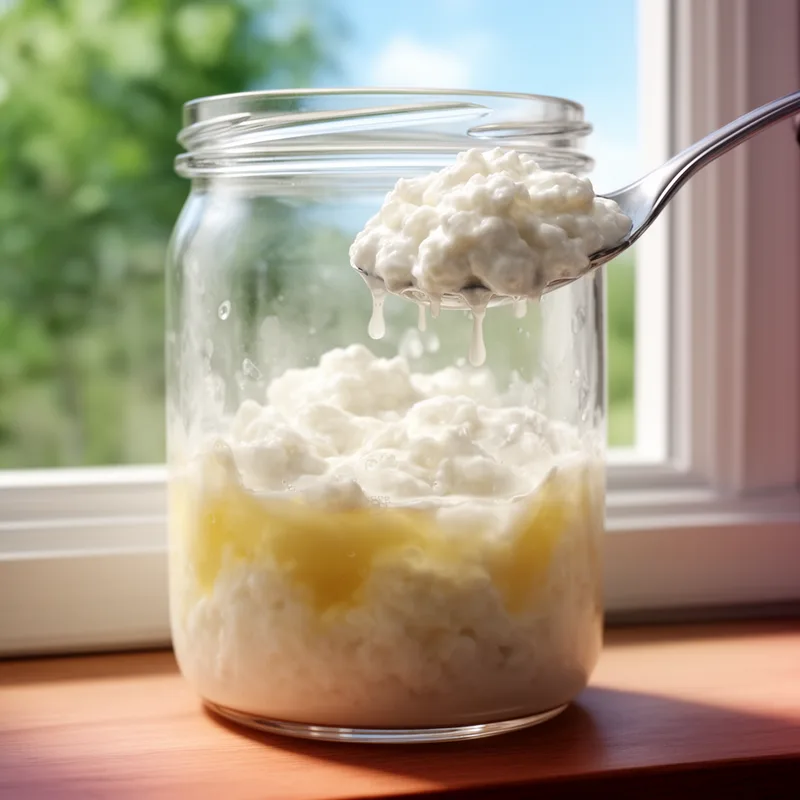
to clabber up
- phrasal verb
- /ˈklæbər ʌp/
- Archaic
- If you leave fresh milk out in the heat, it will clabber up overnight.
Examples
-
Don't let the milk clabber up in the fridge!
-
The recipe called for the cream to clabber up before being churned into butter.
-
She forgot about the jug, and it started to clabber up on the windowsill.
-
If left out too long, the cream will clabber up.
-
If you leave fresh milk out in the heat, it will clabber up overnight.
-
She forgot about the jug, and it started to clabber up on the windowsill.
-
If left out too long, the cream will clabber up into a thick consistency.
Synonyms
 13
4.1
13
4.1

To become thick and form small lumps, like milk when it turns sour
 8
5.6
8
5.6
To become thick and form lumps in a liquid, for example blood or milk

 1
9.9
1
9.9
To become thick and a little sour like milk left out
Antonyms
How Curdled

Surface Forms
Morphology
The verb 'clabber' already denotes milk curdling/thickening and the particle 'up' commonly adds a resultative/completive sense in English, so a learner who knows both constituents can infer ‘to curdle/thicken (completely)’. The construction follows a regular verb + up pattern found cross-linguistically, making the meaning compositionally predictable rather than idiomatic.
Etymology
Clabber up comes from farm life: when milk is left warm it turns thick and lumpy and this is called clabber. With up, the picture is of the milk becoming fully thick, so the phrase means 'to sour' or 'to curdle'.