

to chop up
 56
1.9
56
1.9

- phrasal verb
- /tʃɑp ʌp/
- I will chop up the onions and garlic before starting the sauce.
- chop up vegetables
- chop up onions
- chop up garlic
Loading YouTube…
Watch on YouTubeIt tastes almost like a mix of chopped up salad and veg.
- It tastes almost like a mix of chopped up salad and veg.
- I'm also going to chop up this red pepper.
- Oh, apples taste better chopped up and refrigerated.
- I've got the first layer of cake and we're going to chop up some strawberries.
- What what you chopped up garlic or you put garlic powder on it?
- When octopuses are chopped up and minced and put in a pie, it's an octopi.
- You know, those cups did with the pink chopped up mutant stuff, whatever it is.
Examples
-
You start with a recipe, gather your materials, chop up everything, and cook the prepared ingredients.
Blog text (29) -
As you may know, chopping up gefilte fish takes a long time.
Fiction book (1997) -
And so we're going to simply chop these up like so.
-
If it is not regular, I can chop up the various parts in some way.
-
And we're going to chop this up a little smaller, OK, like so.
-
We need to chop it up and burn it.
-
We can chop it up.
-
Then when we're done chopping it up, we could taste this.
-
I'm also going to chop up this red pepper.
-
I've got the first layer of cake and we're going to chop up some strawberries.
Synonyms
 513
1.3
513
1.3
To break something into two or more parts
 203
1.0
203
1.0
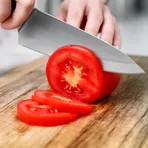
To cut something into thin flat pieces with a knife
 193
1.0
193
1.0
To cut something into pieces using a sharp tool like a knife or axe
 89
2.3
89
2.3
To make something into smaller pieces using a knife or tool
 66
2.7
66
2.7
Separate something into smaller pieces
 53
1.5
53
1.5
Cut meat into slices for serving
 47
2.6
47
2.6
To divide something into smaller parts
 38
3.1
38
3.1
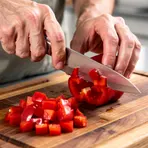
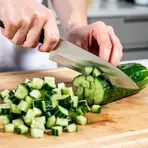
To cut food into very small pieces
 32
1.1
32
1.1
Make something into smaller pieces using scissors or a knife
 12
1.8
12
1.8
To cut wood into pieces for firewood
 9
1.5
9
1.5
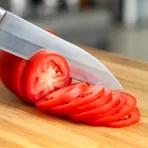
To cut something into thin slices
 8
5.4
8
5.4
Break something into many small parts or hurt someone very badly
 1
3.2
1
3.2
To break something into smaller parts

To chop or split wood with a heavy bladed tool
How Small

Surface Forms
Morphology
chop + up
The meaning is directly derivable from 'chop' (to cut) combined with the particle 'up', which commonly signals cutting into smaller pieces or completion. This verb + particle composition follows a regular English pattern that a B1 learner who knows both constituents will readily understand.
Etymology
Chop up comes from the image of someone using a knife or an axe to chop food or wood again and again until it is in small pieces, with up showing that the thing is broken into many bits. So, chop up means 'to cut something into smaller pieces'.