
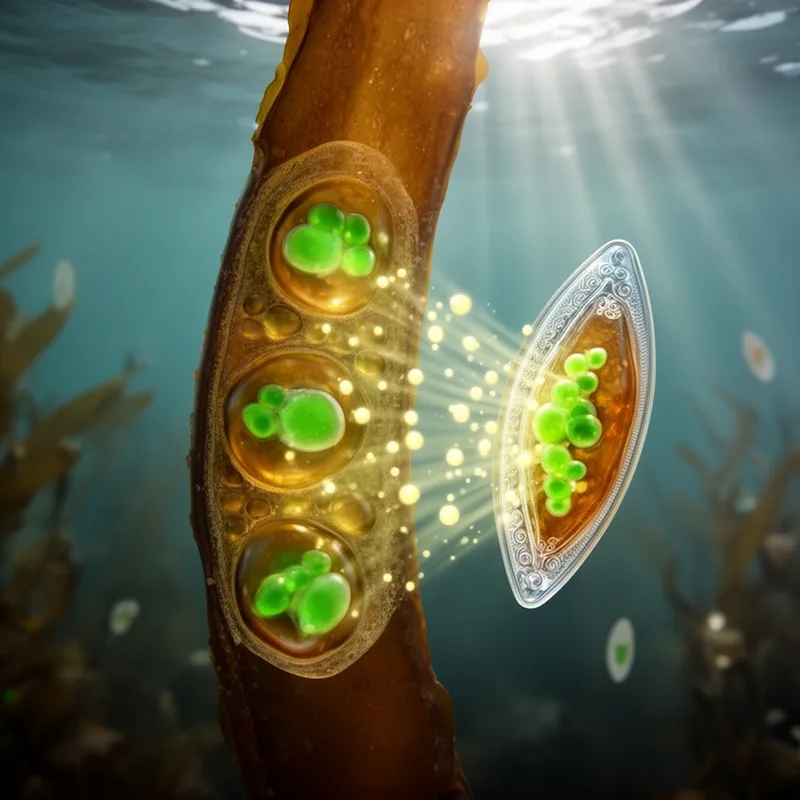
chlorophyll c
- noun
- Specialized
- Many diatoms contain chlorophyll c for energy production.
Examples
-
The chlorophyll c in brown algae helps with photosynthesis.
-
Unlike chlorophyll a, chlorophyll c is not found in green plants.
-
Brown algae owe their color primarily to chlorophyll c and other pigments.
-
The presence of chlorophyll c helps diatoms adapt to different light conditions.
-
The presence of chlorophyll c allows certain marine organisms to convert sunlight into energy.
-
Scientists study chlorophyll c to understand its role in the photosynthesis of flagellates.
-
Chlorophyll c is essential for the photosynthesis process in brown algae and diatoms.
Synonyms
A green pigment that helps brown algae, diatoms, and flagellates take in light
Surface Forms
Morphology
chlorophyll + c
The noun 'chlorophyll' gives the core meaning, so a learner who knows that word can infer this is a particular kind or variant of chlorophyll; however the letter 'c' does not transparently convey the specific biological distribution or function and could be misinterpreted (e.g. as the constant 'c'). Because the item is predictable only as a subtype but not in its detailed meaning or role, it is partially transparent.
Etymology
Chlorophyll c comes from chlorophyll, a word meaning 'green leaf', plus the letter c used to name a different kind. Think of chlorophyll c as the 'c' kind of green pigment that some brown algae and diatoms use to catch light for 'photosynthesis'.

