
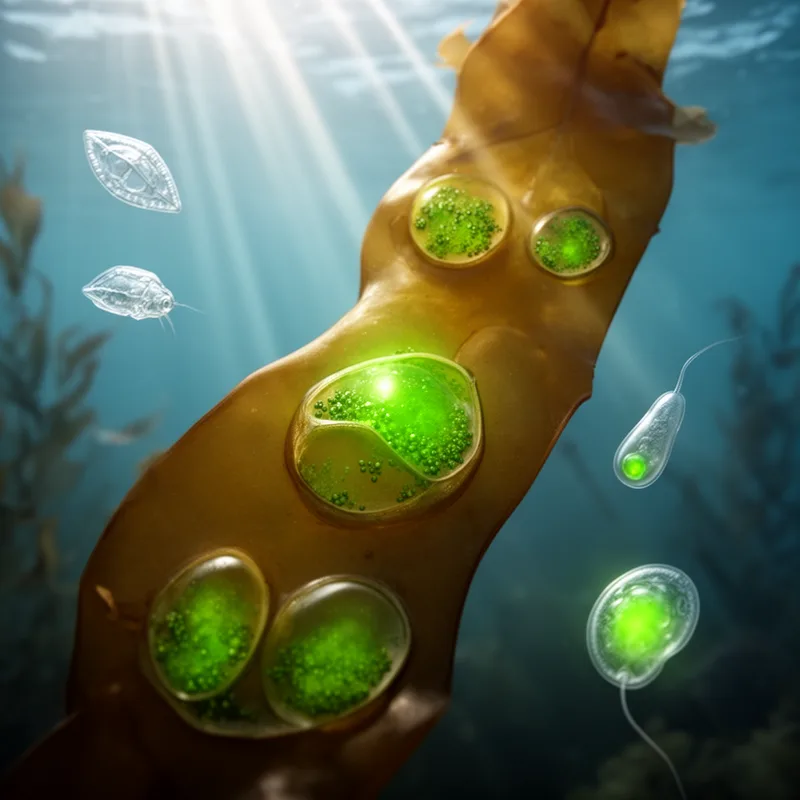
chlorofucin
- noun
- Specialized
- Unlike the chlorophyll found in green plants, chlorofucin is unique to some algae and flagellates.
Examples
-
Brown algae contain chlorofucin, which allows them to absorb light at different wavelengths than land plants.
-
Researchers discovered that chlorofucin plays a crucial role in the photosynthesis of diatoms.
-
The chlorofucin in brown algae helps with photosynthesis.
-
Researchers discovered that chlorofucin plays a crucial role in marine ecosystems.
-
Brown algae contain chlorofucin, which allows them to absorb light at different wavelengths compared to land plants.
-
Researchers discovered that chlorofucin is essential for the photosynthesis process in diatoms.
-
The chlorofucin found in brown algae aids in light absorption and energy production during photosynthesis.
Synonyms

A green pigment in brown algae and tiny water organisms that helps make food from light
Surface Forms
Morphology
chlorofucin = chloro + fucin
This is a technical scientific coinage built from combining forms (e.g., 'chloro-') that are not standalone familiar English words, so an average learner cannot derive the meaning from common vocabulary.
Etymology
Chlorofucin mixes chloro- meaning 'green', as in chlorophyll, with fucin, a part that recalls fucus, an old word for 'seaweed'. So, the name helps you remember it is a 'green pigment' found in brown algae, diatoms, and flagellates.

