
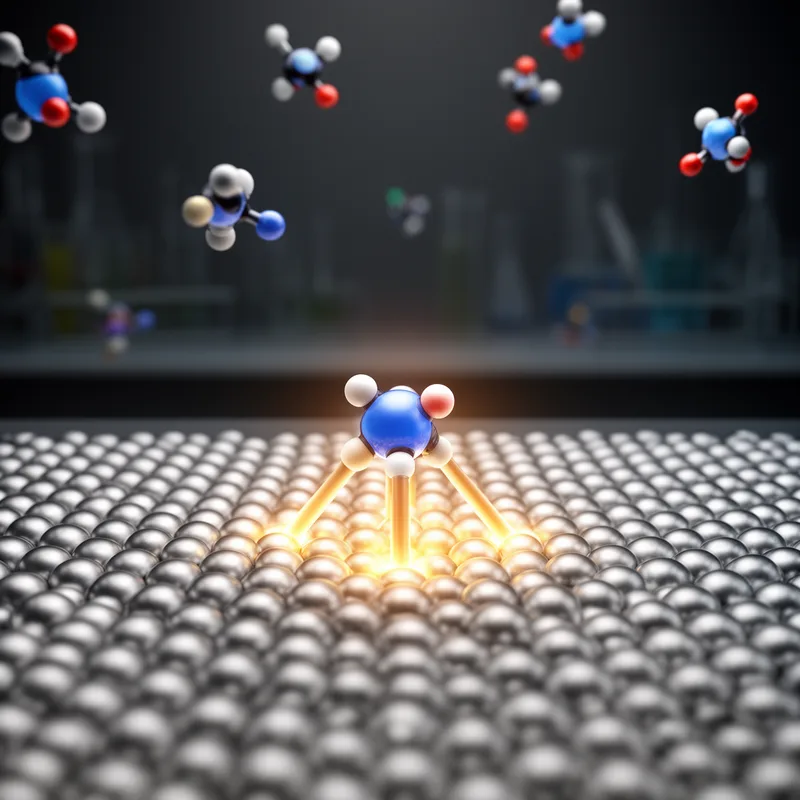
chemisorption
- noun
- /ˌkɛmɪˈsɔrpʃən/
- Specialized
- The chemisorption of hydrogen on platinum is essential in many catalytic reactions.
Examples
-
In chemisorption, molecules form strong chemical bonds.
-
Researchers studied the chemisorption of sulfur dioxide on metal oxide surfaces.
-
Because chemisorption involves stronger bonding, it is often irreversible compared to physisorption.
-
The process of chemisorption is crucial in catalysis.
-
The chemisorption of gases onto the surface of solid catalysts is a key factor in improving reaction rates.
-
During the experiment, the scientists measured the chemisorption of nitrogen on various metal surfaces.
-
Understanding the chemisorption process helps in developing more efficient chemical sensors.
Synonyms

 1
8.9
1
8.9

Tiny particles from a gas or liquid stick to a surface and form a thin layer
Small amounts of gas or liquid stick to a solid surface and form a thin layer

A process where a material takes in or holds another substance
How Strong
- Specialized

- Specialized
1
8.9
Surface Forms
Morphology
Etymology
Chemisorption joins chemi- as in chemical or chemistry and sorption like 'absorb' or 'adsorb', with 'sorption' meaning 'take up' or 'stick to'. So, chemisorption is when a substance 'sticks' to a surface by forming 'chemical bonds', and this sticking is often hard to reverse.