

chemical element
 3
3.7
3
3.7

- noun
- /ˈkɛmɪkəl ˈɛlɪmənt/
- Specialized
- Stars create chemical elements, including those that actually make up our bodies.
- various chemical elements
Examples
-
One is the ratio of hydrogen (the most abundant chemical element in the Sun) to helium (the next most abundant element).
Academic text (1991) -
The spacecraft has an instrument to identify chemical elements by the gamma rays they give off.
-
To test his theory fully, it was necessary to know the actual pattern of energy levels for each chemical element.
Academic text (1993) -
Unlike the other chemical elements, they are easily destroyed by nuclear fusion reactions inside stars.
Academic text (1993) -
The second area was the identification of the chemical elements responsible for thousands of lines in the spectrum of sunlight.
Academic text (1990) -
The Gamma Ray Spectrometer will study chemical elements on or near the surface of Mars.
Academic text (1992) -
A chemical element can occur in nature in several varieties called isotopes.
Academic text (2003) -
Each chemical element or compound produces its own characteristic set of absorption lines, as unique as a fingerprint.
Academic text (2004) -
By scientific convention, the country in which a new chemical element is discovered is given the honor of naming it; when element 02 was isolated in Sweden in 1958, it was christened Nobelium.
Academic text (2000) -
Isotopes are forms of the atoms of a given chemical element that differ slightly in mass.
Synonyms
 102
3.5
102
3.5
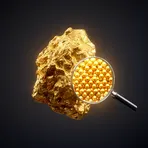
A simple substance made of one kind of atom that cannot be split into smaller parts
Surface Forms
Morphology
The meaning is directly compositional: 'chemical' (relating to chemistry) modifies 'element' (a substance), so 'chemical element' straightforwardly denotes an elemental substance in chemistry. This matches common cross-linguistic patterns and would be derivable by a B1 learner who knows both constituent words.
Etymology
The compound noun chemical element comes from the old idea of an element as a basic part and chemical meaning a substance. It means a pure substance made of atoms that all have the same number of protons, a tiny particle inside the atom, so it cannot be broken into simpler substances.