
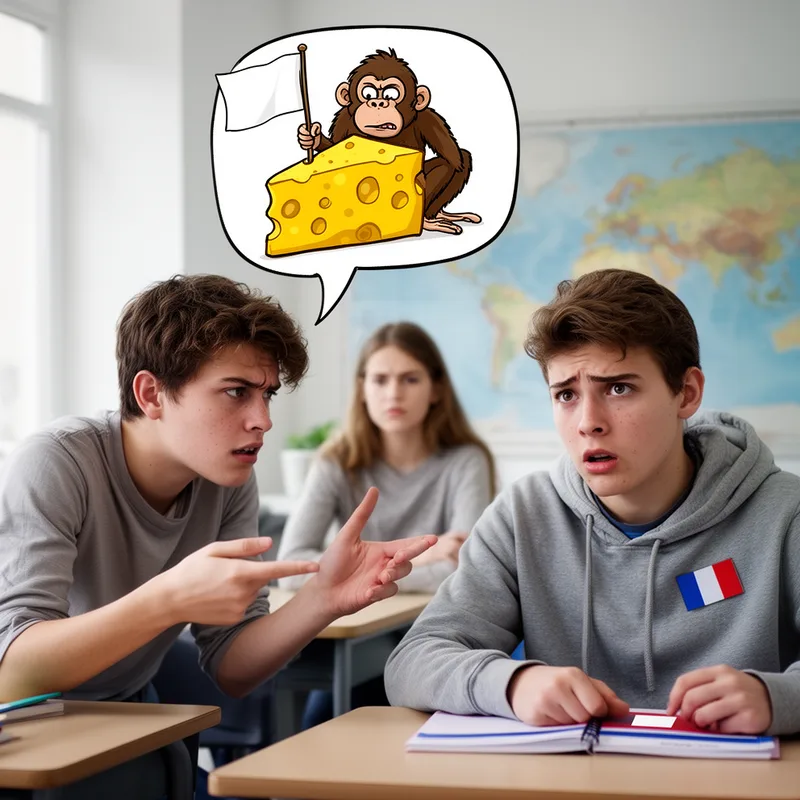
cheese-eating surrender monkey
- noun
- /ˈtʃiːzˌiːtɪŋ sɪnˈdɜːr mʌŋki/
- Slur
- Some critics dismissed the diplomat as a cheese-eating surrender monkey for not standing firm in negotiations.
Examples
-
He called the opposing team a cheese-eating surrender monkey after their lackluster performance.
-
The phrase cheese-eating surrender monkeys was used in a satirical editorial about political appeasement.
-
Don't be a cheese-eating surrender monkey!
-
He called them a bunch of cheese-eating surrender monkeys after they backed down.
-
The coach labeled his team a bunch of cheese-eating surrender monkeys after they gave up in the final minutes of the game.
-
Critics referred to the negotiators as cheese-eating surrender monkeys for their failure to hold their ground during the discussions.
-
In the debate, he called his opponent a cheese-eating surrender monkey for quickly conceding on important issues.
Synonyms

 1
7.7
1
7.7

A person expected to be brave but who acts afraid

A very insulting name for someone who seems extremely scared

A person who gives up during a fight or competition
Antonyms

Surface Forms
Morphology
cheese-eating + surrender + monkey
The components give strong clues: 'cheese-eating' invokes a culinary stereotype and 'surrender' + 'monkey' combines yielding with an insulting animal label, so a learner who knows the words can infer this is a derogatory insult for someone seen as cowardly. However, the precise target (specifically mocking the French) and the fixed idiomatic collocation rely on cultural/pragmatic knowledge and offensiveness that are not fully predictable from the parts, so full meaning requires exposure.
Etymology
Cheese-eating surrender monkey may come from a joking image that joins three things: cheese-eating (to point to French food), surrender (to give up in a fight), and monkey (an insulting way to call someone silly). That's why the phrase is an offensive joke used to call someone 'cowardly' or ready to give up.