
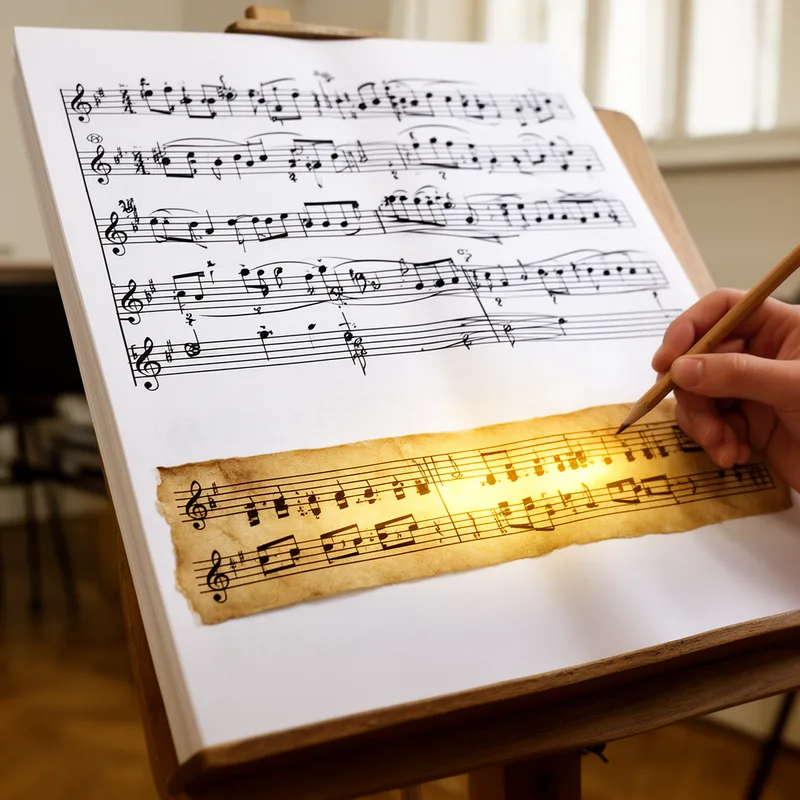
cantus firmus
- noun
- /ˈkæn.təs ˈfɜr.məs/
- Specialized
- Characteristically, the cantus firmus is the plainchant tune with an elongated rhythm.
- given a cantus firmus
Examples
-
Bach used the "Credo" from Liber Usualis as the cantus firmus and as a unifying element in this movement of the B Minor Mass.
Academic text (2003) -
Assign partners; have each pair use one phrase of the song as a cantus firmus and write a more ornamented and quickly moving part above.
Academic text (2003) -
Review plainchant and cantus firmus.
Academic text (2003) -
Assign students to groups to research cantus firmus, J. S. Bach, and B Minor Mass and present information to the class.
Academic text (2003) -
The evaluation is made by taking a cantus firmus and comparing examples from the book of Jeppesen & Glen 60.
Academic text (2018) -
The input layer represents the notes coming from the cantus firmus, and the output layer represents the new counterpoint generated.
Academic text (2018) -
Their main goal is to create small fragments of counterpoint, given a cantus firmus, following rules as closely as the examples in the book, but not to the real Renaissance style.
Academic text (2018) -
Counterpoint problems on the AP Music Theory Exam may require choosing the best counterpoint to a given cantus firmus.
Academic text (1993) -
According to Bonhoeffer, the church's cantus firmus, its fixed traditional melody, must remain in place yet invite the addition and innovation of other voices into the flow of the music.
Academic text (2000) -
In his composition, Bach skillfully integrated a cantus firmus as the foundation for the counterpoint melodies.
Synonyms

The main tune in music with several separate parts, often from church chant

The highest singing part in a choir, often the main melody
How Central


Surface Forms
Morphology
cantus + firmus
The meaning is compositionally predictable if one recognises the Latin constituents — 'cantus' (melody) + 'firmus' (from Latin 'firmus' = firm/fixed) yields 'fixed or pre-existing melody'. However both elements are Latin technical terms (and 'firmus' lacks an English dictionary entry here), so the relation is only partially accessible to an average B1 learner without prior exposure or knowledge of Latin-derived morphology.
Etymology
Cantus firmus comes from the Latin words cantus and firmus, and literally means 'fixed song'. In early music composers kept one melody the same while other parts moved around it, so the term came to mean 'a melody used as the stable base for a piece'.