
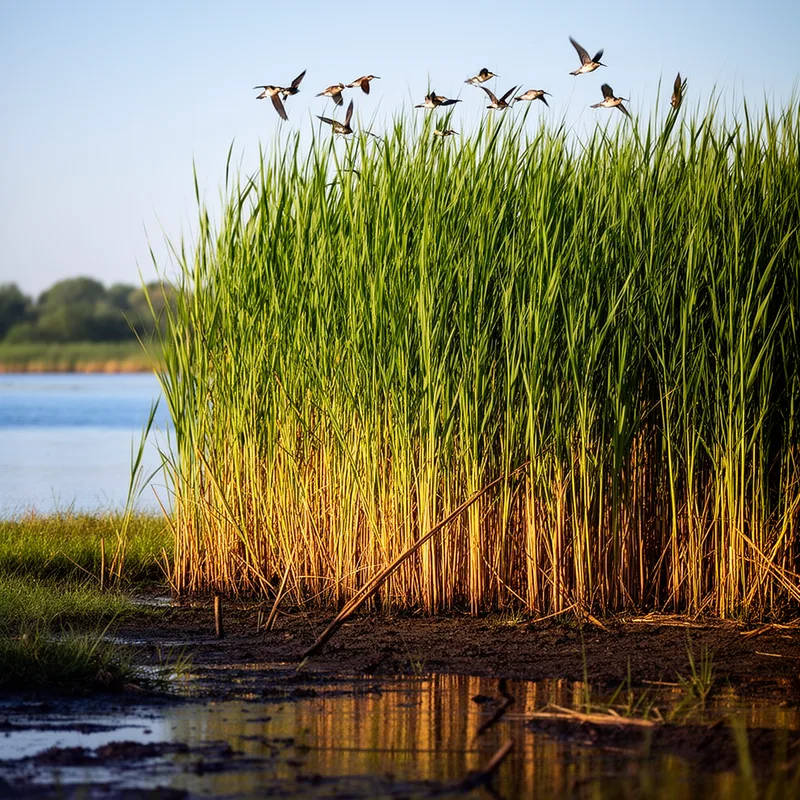
canebrake


 1
9.9
1
9.9
- noun
- /ˈkeɪnˌbreɪk/
- US
- What had been wild grass surrounding the cottage on my first visit had given way to swaying canebrakes—stalks five and six feet tall, their pale golden tassels agitated by wind.
- canebrake rattler
- canebrake rattlesnake
- canebrake wren
Examples
-
I break across a granite ledge and drop into a canebrake.
Fiction book (1995) -
Mrs. Thayer leaned over to check on Wendell Prince's garter snake, Buster, which he had found in a canebrake at Christian Creek.
Fiction book (1998) -
Down in the canebrake, close by the mill
-
Dennis was at the edge of the canebrake running full out.
Fiction book (2001) -
After a while, hearing several more horses coming behind him, he stepped out of the road and lay down in a small canebrake.
Fiction book (1992) -
His mother kept his little girl in a paintless house downstate near the canebrakes.
Fiction book (1997) -
"All of this province," he wrote, "is full of big and dense canebrakes that one can only move through with great effort" (Cieza de Leon 1864).
Academic text (1991) -
Early chroniclers were awed by the immensity and extent of these canebrakes and by the diversity of uses that the native people made of the jointed culms or stems.
Academic text (1991) -
Llenor stood on a dusty bank, beside a huge sparkling sheet of muddy water a couple of klicks across, bordered by levees and canebrake.
Fiction book (1998) -
The dense canebrake provided shelter for various animals in the wetland.
Compounds

A large venomous rattlesnake like a timber rattlesnake that lives in southeastern United States forests and cane fields

A large venomous snake with a rattle that lives in wooded areas of the southeastern United States
How Dense

Surface Forms
Morphology
Etymology
Canebrake comes from the two parts cane and brake, where brake once meant a 'thicket' or 'brush'. So a canebrake is literally a 'thicket of cane', which is why it means a dense growth of tall cane in wet areas.