
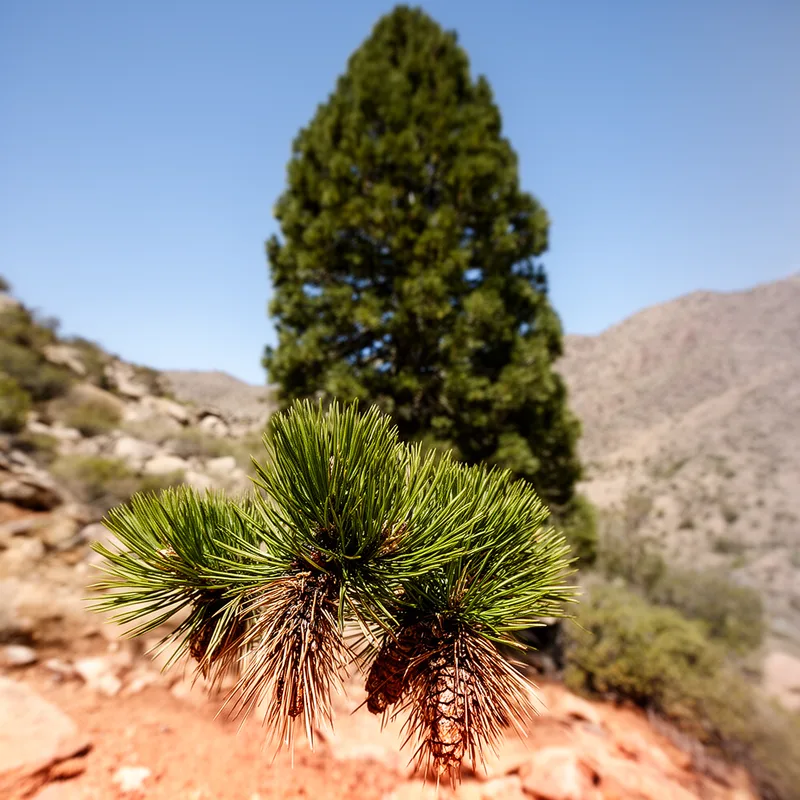
bristlecone fir
- noun
- /ˈbrɪsəlˌkoʊn fɪr/
- US
- The bristlecone fir has a distinctive pyramidal shape and spiny pointed leaves.
Examples
-
The bristlecone fir is well adapted to the rugged terrain of southwestern California.
-
Botanists studied the unique cones of the bristlecone fir during their fieldwork.
-
A mature bristlecone fir can live for several hundred years in its native habitat.
-
The bristlecone fir is one of the oldest living trees.
-
Many bristlecone firs can be found in the White Mountains.
-
In the White Mountains, the bristlecone fir grows in harsh environments that few other trees can survive.
-
Due to its longevity, the bristlecone fir is often studied by researchers looking at climate change.
Synonyms

 22
1.6
22
1.6

A tall evergreen tree with needle leaves and upright cones often used as a Christmas tree
 5
2.0
5
2.0
A tall evergreen tree with soft needles often used for holiday decoration

A cone-shaped fir tree from southwestern California with sharp leaves and spiny cones

A tall fir tree with spiny pointed leaves and cones found only in a small area of California

A rare tall evergreen tree with sharp leaves and spiny cones from southwestern California

A tall evergreen tree with needle leaves and upright cones often used as a Christmas tree
Surface Forms
Morphology
bristlecone + fir
Although 'bristlecone' is an infrequent lexical item, it is transparently built from 'bristle' + 'cone' and modifies 'fir', so a learner who knows 'bristle' (stiff hair), 'cone' and 'fir' can infer this refers to a fir tree with bristly/spiny cones or bristle-like features. The adjective+noun composition is a regular, cross-linguistic pattern, making the basic meaning derivable for a B1 learner who knows the constituents.
Etymology
Bristlecone fir gets its name from the tree's small cones that have long, stiff bristles, so the cones look like tiny spiky brushes. That's why the name describes a 'fir' with bristle-like cones and sharp leaves.