
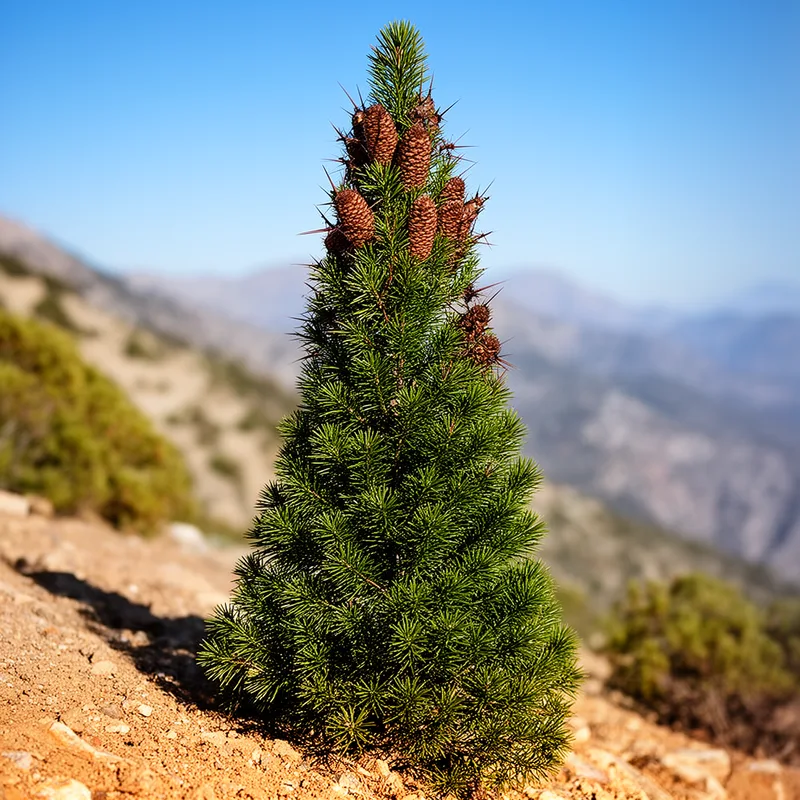
Abies venusta
- noun
- Specialized
- The Abies venusta is known for its distinctive pyramidal shape and spiny leaves.
Examples
-
Botanists studied the unique cone structure of the Abies venusta.
-
The Abies venusta is well adapted to the mountainous regions of southwestern California.
-
Conservation efforts have increased to protect the habitat of Abies venusta.
-
The Abies venusta is a beautiful addition to any garden.
-
Many gardeners admire the Abies venusta for its unique appearance.
-
In southwestern California, the Abies venusta thrives in mountainous terrain.
-
Visitors to the park came to see the impressive Abies venusta with its unique cone scales.
Synonyms

A tall fir tree with spiny pointed leaves and cones found only in a small area of California

A tall evergreen tree from southwestern California with sharp needle-like leaves and cones that have long spines

A rare tall evergreen tree with sharp leaves and spiny cones from southwestern California
Surface Forms
Morphology
Abies + venusta
This is a Latin scientific binomial rather than a compositional English phrase: 'Abies' is a genus name and 'venusta' is not an English lexical item, so a B1 learner who knows ordinary English words would not be able to derive the species meaning. Botanical Latin names are language-specific labels and do not follow ordinary English semantic composition, making the expression unpredictable to learners.
Etymology
Abies venusta comes from Latin words: Abies means 'fir' and venusta means 'charming' or 'graceful'. The tree's neat pyramid shape and shiny pointed leaves likely gave it that name, so the name helps you remember it is a graceful fir tree.

