

besieging
- noun
- /bɪˈsiːdʒɪŋ/
- The city's defenses were strong, making the besieging a challenging task for the troops.
Examples
-
She can thus blockade coastal cities and facilitate the total and more hasty besieging of such cities.
-
The general planned the besieging of the castle to force its inhabitants to surrender.
-
After months of besieging, the army finally captured the fortified town.
Synonyms

 139
6.8
139
6.8

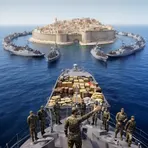
A military attack that surrounds a place and stops supplies to make those inside give up
 2
7.5
2
7.5
Surrounding a place or army to cut off supplies and stop escape

 1
6.7
1
6.7
Soldiers or ships surround a place to stop supplies and force it to give up

A military action that surrounds a fort or city and cuts off its supplies
Antonyms

How Intense

Surface Forms
Morphology
Etymology
Besieging comes from an old idea of 'sitting' around a place: the parts be- and siege share the same idea as the English word seat, which means 'to sit'. So, to besiege is to 'sit around' a fort or city, surrounding it and waiting for it to 'surrender'.