
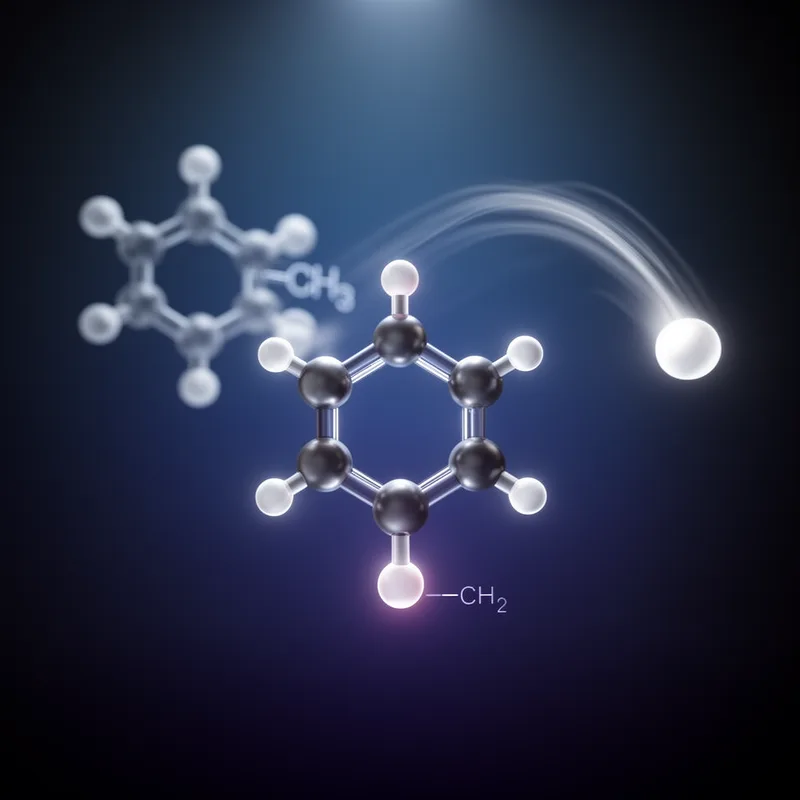
benzyl group
- noun
- /ˈbɛn.zɪl ɡruːp/
- Specialized
 :
grupo bencilo
:
grupo bencilo
- When a hydrogen atom is removed from the methyl group of toluene, a benzyl group is formed.
Examples
-
The benzyl group is commonly used in organic synthesis as a protecting group for alcohols.
-
Many pharmaceuticals contain a benzyl group as part of their molecular structure.
-
The benzyl group is commonly found in organic chemistry.
-
A benzyl group can stabilize certain chemical compounds.
-
Many pharmaceuticals contain a benzyl group as part of their molecular structure.
-
The benzyl group is commonly used in organic synthesis as a protecting group for alcohols.
-
When a hydrogen atom is removed from the methyl group of toluene, a benzyl group is formed.
Synonyms


 1
8.7
1
8.7
A part of a molecule with a six-carbon ring and a CH2 that attaches to other molecules

A small chemical group formed when toluene loses one hydrogen atom from its methyl part
Surface Forms
Morphology
The term is a straightforward noun–noun composition: a 'group' that is specifically the 'benzyl' radical. If a learner knows 'benzyl' (a radical derived from toluene) and 'group' (a bonded assembly of atoms), the combined meaning is directly derivable and follows regular chemical naming conventions, making it transparent.
Etymology
Benzyl group comes from benzene and the ending -yl, which chemists use for a part missing one hydrogen. Imagine a benzene ring with a short 'arm' CH2 that has lost a hydrogen so it can 'attach' to other parts, and that image explains why a benzyl group is the part that 'joins' to make larger molecules.