
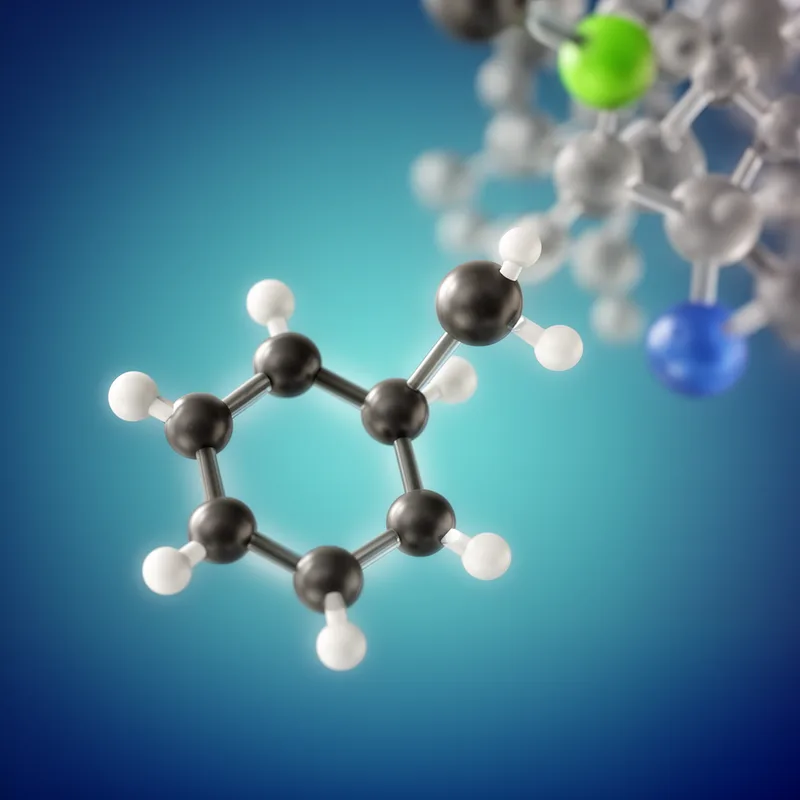
benzyl


 1
8.7
1
8.7
- noun
- /ˈbɛn.zɪl/
- Specialized
- Benzyl cyanide and some deaminating agents, too.
- benzyl alcohol
Loading YouTube…
Watch on YouTubeYou can use the benzyl peroxide, that's perfectly fine.
- You can use the benzyl peroxide, that's perfectly fine.
Examples
-
Chemists frequently work with benzyl groups when synthesizing various organic compounds.
-
OK, now let's look at these others, allyl and benzyl, where it's an unusually easy bond to break.
-
You can use the benzyl peroxide, that's perfectly fine.
-
The other possibility is analogous to what we saw over here in the allyl and benzyl cases, right?
-
So it's got a big honkin sugar Group, A ramnose sugar group and and a benzyl group attached to this NCS.
-
Benzyl alcohol is often used as a solvent in many pharmaceutical formulations.
-
The reaction yielded a product that included benzyl acetate, a common organic compound.
Synonyms

A part of a molecule made from toluene when one hydrogen is removed from its methyl group

A small chemical group formed when toluene loses one hydrogen atom from its methyl part
Compounds
- Specialized
A part of a molecule made from toluene when one hydrogen is removed from its methyl group
- Specialized
A small chemical group formed when toluene loses one hydrogen atom from its methyl part
Surface Forms
Morphology
benzyl = toluene (semi-transparent) = benz + yl
The form is a regular chemical formation (benz- + -yl) so it is clear to those with chemistry knowledge, but the specialized suffix '-yl' and the combining form 'benz-' are unlikely to be transparent to general B1 learners.
Etymology
Benzyl comes from benzene, a name made from benzoin, a sweet-smelling 'resin' once used in perfumes; the ending -yl means a 'small chemical group'. So a benzyl group is simply the benzene part as a single piece that chemists attach to other molecules, which is why the word means that common group in organic chemistry.