

battle of Ypres
- proper noun
- /ˈbætəl əv ˈiːprə/
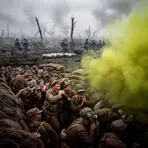
- The battle of Ypres marked a significant use of chemical weapons during World War I.
Examples
-
Commemorative events are held annually to honor those who fought in the battle of Ypres.
-
Many soldiers suffered due to harsh conditions at the battle of Ypres in 1917.
-
The battle of Ypres was a significant event in World War I.
-
Many soldiers fought bravely during the battle of Ypres.
-
Commemorative events are held annually to honor those who fought in the battle of Ypres.
-
Many soldiers suffered due to harsh conditions at the battle of Ypres in 1917.
-
The battle of Ypres marked a significant use of chemical weapons during World War I.
Synonyms


 1
7.8
1
7.8
A World War I battle near Ypres where Germans first used poison gas on a large scale
Surface Forms
Morphology
The meaning is compositionally derived from 'battle' + 'of' + a place name: a B1 learner who knows 'battle' and recognizes (or infers) 'Ypres' as a location will understand this refers to a military engagement at Ypres. This place-of construction is a standard, cross-linguistic pattern, so the overall meaning is directly predictable from the constituents.
Etymology
Battle of Ypres: The name battle of Ypres comes from the town Ypres in Belgium, where several major battles of World War I were fought. One famous fight in 1917 saw tanks get stuck in deep mud and the first use of 'mustard gas', so battle of Ypres now brings to mind muddy fields and very harsh fighting.