
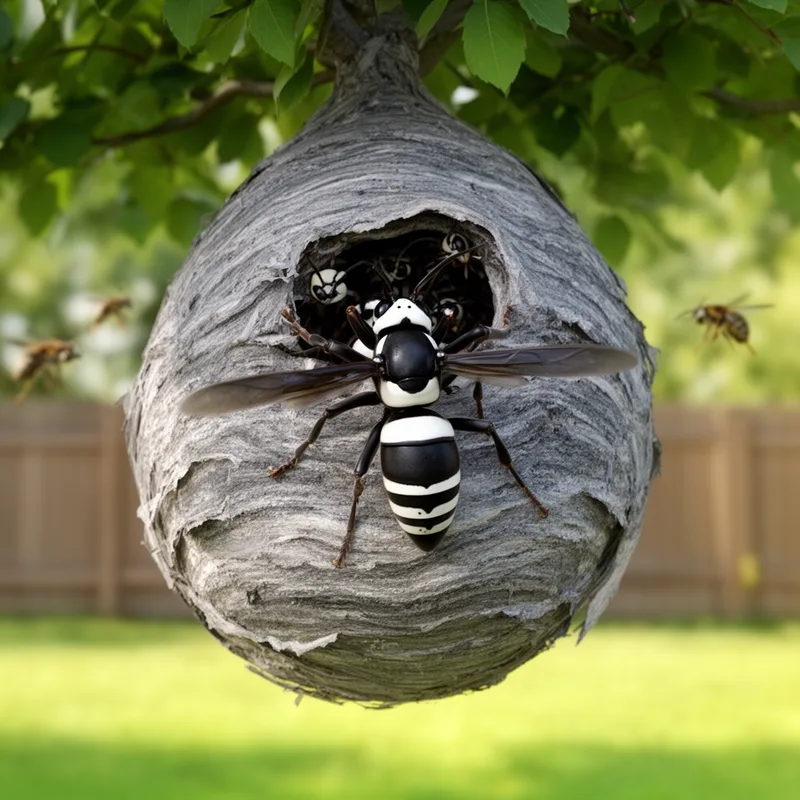
bald-faced hornet
- noun
- /bɔld feɪst hɔrnɪt/
- US
- Scientists observed a colony of bald-faced hornets constructing their papery hive high in the trees.
Examples
-
The sting of a bald-faced hornet can be very painful if you accidentally disturb its nest.
-
A bald-faced hornet built a large nest in the corner of our backyard last summer.
-
The bald-faced hornet is known for its aggressive behavior.
-
Have you ever seen a bald-faced hornet up close?
-
A bald-faced hornet built a large nest in the corner of our backyard last summer.
-
Scientists observed a colony of bald-faced hornets constructing their papery hive high in the trees.
-
The sting of a bald-faced hornet can be very painful if you accidentally disturb its nest.
Synonyms
A large black and white wasp often called the bald-faced hornet that makes big paper nests
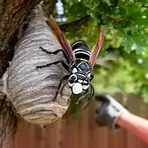
A large black and white wasp with a pale face that can sting people and becomes aggressive when threatened
Surface Forms
Morphology
The noun is a straightforward adjective + noun composition: 'bald-faced' describes a facial marking and 'hornet' names the insect, so a learner who knows both constituents can infer it refers to a hornet with a pale/white face. This descriptive, literal naming pattern is cross-linguistically common and follows regular English adjective+noun composition, making the MWE immediately comprehensible to B1 learners who know the parts.
Etymology
Bald-faced hornet is named for how it looks: this black hornet has a pale white patch on its face and body that can look like a 'bald' face. The part bald-faced points to that pale marking and hornet tells you it is a stinging insect. That's why the name means a large black-and-white hornet that builds paper nests and fiercely defends them.

