

Vespula maculata
- noun
- Specialized
- Some people refer to the Vespula maculata as the bald-faced hornet due to its distinctive markings.
Examples
-
If you disturb a Vespula maculata nest, the hornets can become very aggressive.
-
A large Vespula maculata nest hung from the tree near the edge of the forest.
-
The Vespula maculata is often mistaken for a wasp.
-
Is that a Vespula maculata nest?
-
A large Vespula maculata nest hung from the tree near the edge of the forest.
-
If you disturb a Vespula maculata nest, the hornets can become very aggressive.
-
Some people refer to the Vespula maculata as the bald-faced hornet due to its distinctive markings.
Synonyms

A large black and white hornet in North America that builds paper nests in trees and defends them
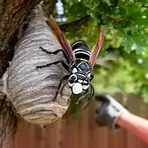
A large black and white wasp with a pale face that can sting people and becomes aggressive when threatened
Surface Forms
Morphology
Vespula + maculata
The binomial form 'Vespula maculata' transparently signals a taxonomic name: knowing 'Vespula' (a genus of social wasps) lets a learner infer this is a kind of wasp/hornet. However 'maculata' is a Latin species epithet (not a standard English word and not defined here), so a B1 learner would not reliably derive the specific sense or common name; taxonomic composition is partially transparent but not fully predictable to learners.
Etymology
Vespula maculata comes from Latin: Vespula means 'little wasp' and maculata means 'spotted', which describes the hornet's white markings on a dark face and body. That's why the name refers to the hornet people often call the 'bald-faced hornet'.

