
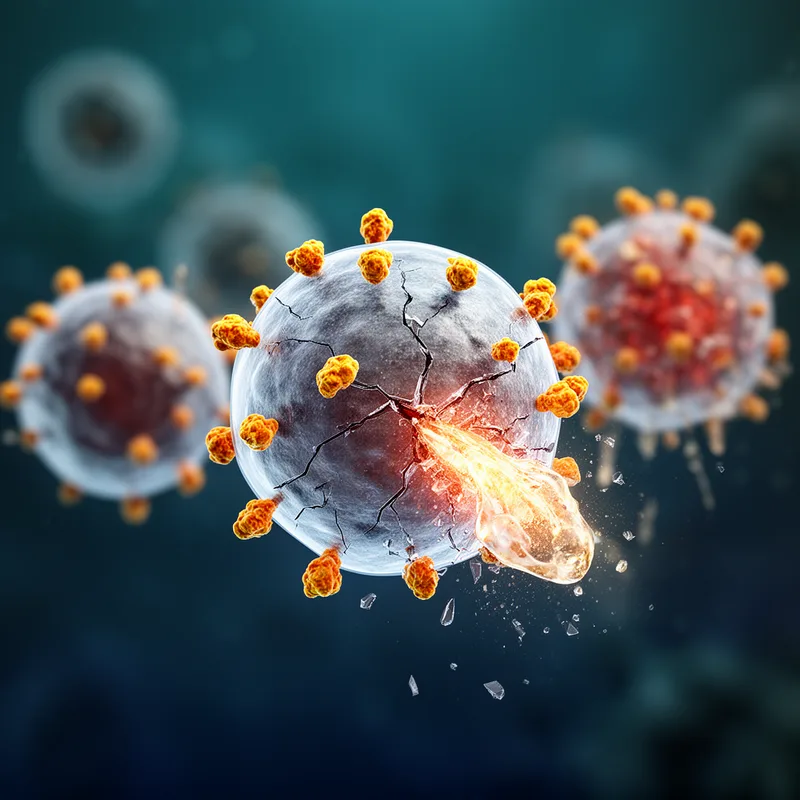
autolysin
- noun
- /ˌɔːtəˈlaɪsɪn/
- Specialized
- The autolysin produced by the bacteria breaks down its cell wall, leading to cell lysis.
Examples
-
Similarly, removal of bacterial cell walls through lysozyme, autolysin, or penicillin results in massive lysis in low-osmotic-strength media.
Academic text (1993) -
Scientists studied how autolysin facilitates bacterial cell destruction during infection.
-
In the B. subtilis system, inheritance of the wall-less state depends on a stabilized equilibrium between post-translational gene products: nascent cell wall and an enzyme, autolysin, that keeps destroying the wall.
Academic text (1993) -
When exposed to autolysin, the bacterial cells undergo lysis and release their contents.
Synonyms
A protein made by viruses that infect bacteria that breaks their cell walls

A natural substance in saliva, sweat, and tears that breaks the cell walls of some bacteria
A protein in tears, saliva and sweat that kills some bacteria
Surface Forms
Morphology
Etymology
Autolysin comes from Greek parts auto- 'self' and -lysin 'to break'. So an autolysin is an enzyme that helps a cell 'break itself', which is why it can make bacteria break their own cell walls and fall apart.

