

artiodactyl mammal
- noun
- /ˌɑrtiˈɑdæktɪl ˈmæməl/
- Specialized
- Pigs, as artiodactyl mammals, have two main weight-bearing toes on each hoof.
Examples
-
The giraffe is an example of an artiodactyl mammal native to Africa.
-
Many artiodactyl mammals are herbivores, feeding on grass.
-
The study focused on the evolutionary history of artiodactyl mammals and their adaptation to various habitats.
-
An artiodactyl mammal like a deer can run very fast.
-
Pigs, as artiodactyl mammals, have two main weight-bearing toes on each hoof.
-
The giraffe is an example of an artiodactyl mammal native to Africa.
-
Many artiodactyl mammals such as deer and camels are important in agricultural ecosystems.
Synonyms


 1
9.9
1
9.9
A hoofed animal with an even number of toes, like a cow or sheep
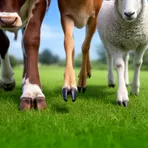
A mammal with hooves that walks on an even number of toes, like cows or deer
Surface Forms
Morphology
The phrase simply combines the two constituent meanings: 'artiodactyl' (a member of Artiodactyla with cloven hooves) qualifies the head noun 'mammal', so the meaning is directly 'a mammal that is an artiodactyl'. This noun–noun specification is compositional and cross-linguistically common, so a learner who knows both words will readily infer the MWE meaning.
Etymology
Artiodactyl mammal comes from two old Greek parts: artio- meaning 'even' and -dactyl meaning 'toe' or 'finger'. It literally describes animals with an 'even' number of 'toes', so today artiodactyl mammal refers to hoofed mammals like deer, pigs, and camels.