
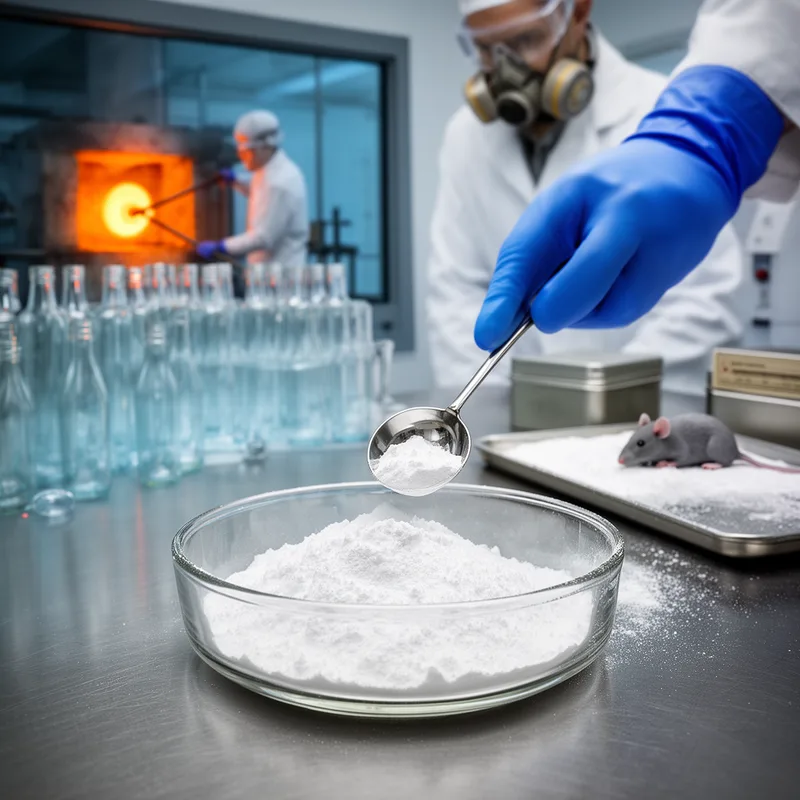
arsenous anhydride
- noun
- /ˈɑːrsənəs ˈænhaɪdraɪd/
- Specialized
- Because of its toxicity, handling arsenous anhydride requires protective equipment and strict safety procedures.
Examples
-
The factory uses arsenous anhydride in its glass production.
-
Historically, arsenous anhydride was infamously used as a rat poison.
-
The factory uses arsenous anhydride in its glass-making process.
-
Many pesticides contain arsenous anhydride as a key ingredient.
-
Because of its toxicity, handling arsenous anhydride requires protective equipment and strict safety procedures.
-
The factory uses arsenous anhydride in its glass-making process.
-
Many pesticides contain arsenous anhydride as a key ingredient.
Synonyms

 6
6.6
6
6.6

A white poisonous powder used as rat poison and to make glass

 1
9.3
1
9.3
A poisonous white powder used to kill pests and make glass
A white poisonous powder used to make glass and kill pests
A poisonous white powder that people use to make glass and to kill pests or weeds

A poisonous substance for killing rats, often made from arsenic trioxide
Surface Forms
Morphology
arsenous + anhydride
The phrase is compositionally built from a modifier meaning 'related to arsenic' (arsenous) and a chemical class term (anhydride), so a learner who knows both constituents can infer it denotes an anhydride of an arsenic-containing acid — i.e., an arsenic-derived chemical compound. Chemical naming conventions are cross-linguistically regular, making the overall meaning predictable from the parts rather than idiomatic.
Etymology
Arsenous anhydride comes from two parts: arsenous meaning 'related to arsenic' and anhydride meaning 'without water', so the name points to a dry form of arsenic. That's why the word refers to the white, poisonous powder used in glass making and pesticides.