

anhydride


 1
9.9
1
9.9
- noun
- /ˈænhaɪˌdraɪd/
- Specialized
- In the laboratory, chemists often use acetic anhydride to synthesize various organic compounds.
- acetic anhydride
- maleic anhydride
- anhydride hydrolysis
Loading YouTube…
Watch on YouTubeAnd what we came up with was that the bonds we wanted to use were what are called the anhydride bonds.
- And what we came up with was that the bonds we wanted to use were what are called the anhydride bonds.
Examples
-
Anhydrides are known to undergo base hydrolysis rapidly in solution.
Academic text (2001) -
The anhydride structure was incorporated into addition polymers in several ways.
Academic text (2001) -
However, the anhydride hydrolysis could cause some problems as well.
Academic text (2001) -
And if you heat these molecules further, the one on the left can lose water and form an anhydride, but not the one on the right.
-
Figure 15 clearly indicates that the anhydride absorptions have completely disappeared after the base treatment.
Academic text (2001) -
Fortunately, however, the anhydride IR absorptions appear outside the water envelope, allowing us to monitor the hydrolysis.
Academic text (2001) -
In this case, the DMA additive functions as a barrier to base penetration and as a protector of anhydride from hydrolysis.
Academic text (2001) -
Aqueous base penetration is believed to be the most important step in the base hydrolysis of anhydride during development, which is essentially controlled by the polarity of the matrix.
Academic text (2001) -
The lipophilic cholates could suppress base penetration, protect anhydride, and reduce undesirable thinning in the unexposed area.
Academic text (2001) -
Without intentional incorporation of carboxylic acid, the NB-MA copolymers tend to contain a small concentration of carboxylic acid due to anhydride hydrolysis during workup.
Academic text (2001)
Synonyms

A compound that forms an acid when it reacts with water, often making two acid molecules

A type of organic chemical that reacts with water to make acids
Compounds

- NSFW
A clear liquid chemical used to change other chemicals when making medicines and sometimes illegal drugs
- Specialized
A compound that forms an acid when it reacts with water, often making two acid molecules
- Specialized
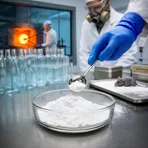
A white poisonous powder used in glass making and in products that kill pests

Surface Forms
Morphology
Etymology
The word anhydride comes from the parts an- 'not' and hydr- 'water', the same root you see in hydrate. So an anhydride is a chemical made 'without water' when water is taken away from an acid.