
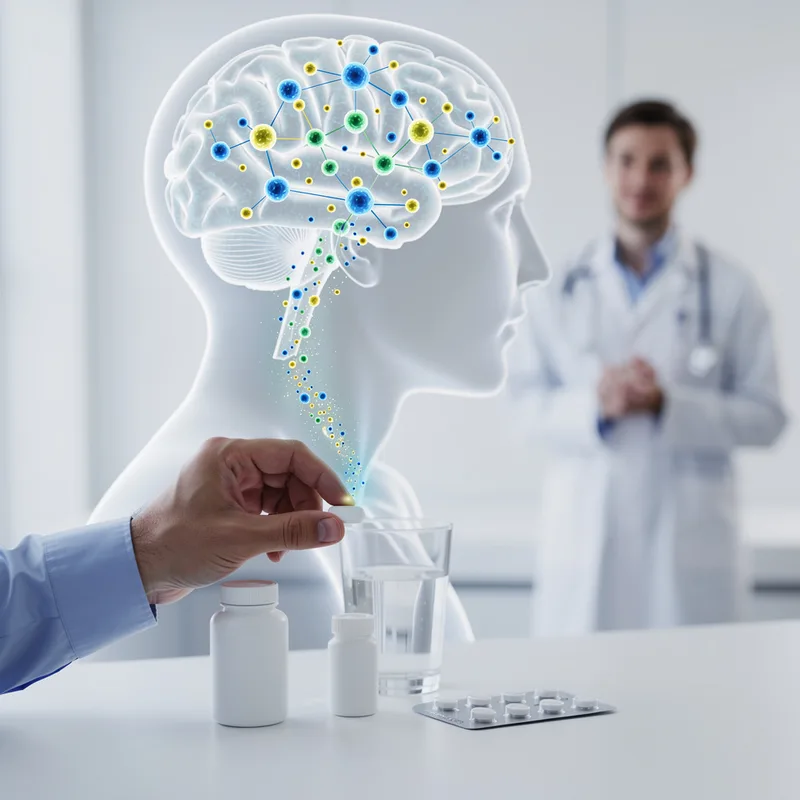
antidepressant drug
 3
3.2
3
3.2

- noun
- /ˌæntiˈdɪprɛsənt drʌg/
- Specialized
- In reality, the newer antidepressant drugs are such a mainstay of treatment for depression that alternatives are rarely considered.
- prescribed an antidepressant drug
- take antidepressant drugs
- antidepressant drug therapy
Examples
-
The doctor recommended an antidepressant drug to help manage her mood swings.
-
The psychiatrist had prescribed an antidepressant drug, but the patient's symptoms persisted.
Academic text (2006) -
Some people who take antidepressant drugs get significant side effects so that, at least at first, they feel a lot worse.
Academic text (2011) -
This analysis was performed according to the class of antidepressant drugs used in the intervention groups.
Academic text (2016) -
Several treatments are available for depression, and antidepressant drug therapy has proven effective for the treatment of symptoms.
Academic text (2016) -
Individual patients vary widely in their susceptibility to both the benefits and side effects of antidepressant drugs.
Academic text (2011) -
Few, if any, antidepressant drug treatments have been proven to work in the long term (specifically SSRIs).
Blog text (26) -
Psychotherapy looks as good or better at relieving depression, especially at one-year follow-ups, as antidepressant drugs.
Academic text (2002) -
Clinical trials completed with newer antidepressant drugs likewise reveal that these drugs are as effective as traditional antidepressants and are safer in terms of adverse side effects (Rush, 1998).
Academic text (2006) -
Many patients find that an antidepressant drug can significantly improve their quality of life.
Synonyms
 103
4.1
103
4.1
A medicine that helps reduce depression and anxiety by changing brain chemicals
 61
3.4
61
3.4
A medicine that treats depression by changing chemicals in the brain
 5
4.1
5
4.1
A medicine that treats depression by increasing a brain chemical called serotonin
 2
4.9
2
4.9
A fast-acting medicine given in low doses to treat severe depression when other medicines do not work
 1
6.4
1
6.4
A medicine used to treat depression and some anxiety by changing chemicals in the brain
 1
4.4
1
4.4
A medicine used to treat depression and anxiety
 1
9.1
1
9.1
A medicine doctors give to treat depression and some long-term nerve pain
 1
5.8
1
5.8
A medicine that treats depression by raising levels of mood chemicals in the brain
 1
7.7
1
7.7
A medicine that treats depression and helps you sleep
 1
6.8
1
6.8
A medicine that blocks an enzyme in the brain to raise mood chemicals


 1
6.5
1
6.5
A medicine that treats depression by raising a brain chemical called serotonin
 1
6.8
1
6.8
A medicine for depression that raises mood chemicals in the brain like serotonin and norepinephrine
 1
9.9
1
9.9
A medicine used to treat depression and sometimes anxiety or bedwetting in children
A medicine used to treat depression that raises some brain chemicals

A medicine for depression that is not a tricyclic and works in a different way from some older drugs

A medicine for depression that is not tricyclic and does not block monoamine oxidase
A medicine for depression that changes chemicals in the brain

A medicine that treats depression and some anxiety by changing chemicals in the brain

A medicine for depression that helps the brain keep more mood chemicals

A medicine given in low doses that works quickly to reduce severe depression when other treatments fail

A medicine used to treat depression

A medicine used to treat depression and some mood problems

A medicine for depression and some nerve pain that can cause serious side effects and mix with other medicines

A medicine used to treat depression and sometimes to help people with ADHD

A medicine doctors use to treat serious mental problems and sometimes stop vomiting
Surface Forms
Morphology
The meaning is fully compositional: 'antidepressant' denotes a medication for depression and 'drug' denotes a medicinal chemical, so together they plainly refer to a medication that treats depression. This follows a regular noun–noun modification pattern found across languages, making the phrase immediately understandable to learners who know both constituents.
Etymology
Antidepressant drug is much like its parts: anti- means 'against', depressant relates to 'depression' or being very sad, and drug means medicine. So the term means a medicine that works against 'depression'.