

ant lion
- noun
- /ˈænt ˈlaɪən/
- Specialized
- The ant lion catches its prey by digging a pit in the sand and waiting for ants to fall in.
Examples
-
Children were fascinated to learn that the ant lion uses its funnel-shaped sand trap to capture unsuspecting ants.
-
This book goes into a lot of detail about how ants communicate, reproduce, and survive, and includes information on some predators, such as the anteater and ant lion.
Academic text (2012) -
As the ant lion matures, it becomes a formidable predator, skilled at trapping small insects.
Synonyms

A small baby insect that makes funnel-shaped traps in dry sand
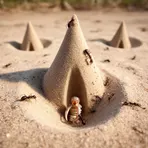
A family of insects whose young dig cone-shaped pits to trap ants and small insects
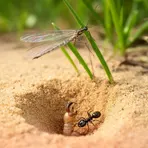
A small insect whose larva digs sand pits to trap ants and whose adult looks like a dragonfly
Surface Forms
Morphology
ant + lion
A B1 learner who knows 'ant' and 'lion' will readily infer a creature that preys on ants because 'lion' functions metaphorically as a predator; the basic predator relation is transparently conveyed. However, the specific sense — that this is the larval stage of a small insect that traps prey in sandy pits — and the taxonomic/life-stage information are not predictable from the parts, so the expression is only partly transparent.
Etymology
Ant lion is the name for the young form of an insect that digs a cone-shaped pit in the sand and waits at the bottom to catch ants. People thought it hunted ants like a tiny lion, so they put together ant and lion to make a name that shows how it traps its prey.

