

to amputate
 48
7.2
48
7.2

- verb
- /ˈæmpjʊˌteɪt/
- Specialized
- There's no option but to amputate the right arm.
- amputate a limb
- amputate a leg
- amputate an arm
Loading YouTube…
Watch on YouTubeAnd yet many people who have amputated limbs report phantom limb pain.
- And yet many people who have amputated limbs report phantom limb pain.
- Her mother saw her, you know, her her aunt and her uncle get their limbs amputated from diabetes.
- All of his limbs became like necrotic and he had to have every single limb amputated.
- That you get problems with your feet and you have in severe cases have to you have your feet amputated.
- I've seen dog with the leg amputated, amputated leg.
- So I would have to go in and they would have to amputate that.
- But to amputate his arm, he's got to break his arm.
- But in that photo, he actually his right leg is amputated.
- His legs were so badly damaged so they amputated.
- I think I may have to amputate my left pinky finger with no context.
Examples
-
We had to amputate portions of your arm, otherwise, you would have bled to death.
-
She's had a toe amputated, a leg amputated, and that went on for some time until she actually passed away.
-
So I would have to go in and they would have to amputate that.
-
Your choices here are to amputate the foot or start with medical care.
-
Now, in order to save her life, doctors had to amputate her legs below the knee and her fingers.
-
We're going to have to amputate both your legs, Gil.
-
A few months later her right leg was amputated at the knee.
-
The next day, his right arm was amputated just below the elbow.
Academic text (2007) -
Within the hour, surgeons had amputated his left leg above the knee.
Academic text (1996) -
The doctor told me if we don't amputate her leg, she will die.
Synonyms
 190
4.1
190
4.1
To remove something by cutting it away from what it is attached to


 1
9.9
1
9.9
Remove a part of the body by surgery or a medical treatment

To remove an organ or body tissue completely by surgery
Antonyms

How Harmful
- Offensive

- Offensive
- Specialized
48
7.2
- NSFW
35
7.0
Surface Forms
Morphology
amputate = amput + ate
The element 'amput-' is a bound combining form and not a standalone English word, so learners cannot reliably derive the meaning from familiar English morphemes despite the recognizable suffix '-ate'.
Etymology
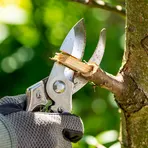
Amputate comes from Latin parts am- meaning 'away' and putare meaning 'to prune' or 'to trim'. Think of cutting a branch away from a tree: to amputate is to cut off a limb or other body part.