

aldehyde group
- noun
- /ˈældaɪhaɪd ɡruːp/
- Specialized
- Sorbitol is a "sugar alcohol"; it is made by the reduction of glucose, converting the aldehyde group of glucose to a hydroxyl group.
Examples
-
An aldehyde group can be identified by the presence of the -CHO structure in a molecule.
-
During the reaction, the aldehyde group was transformed into a carboxylic acid.
-
The aldehyde group is important in organic chemistry because it defines the reactivity of aldehydes.
Synonyms
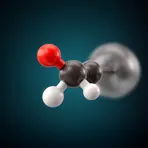
A carbon atom double-bonded to oxygen and single-bonded to hydrogen
Surface Forms
Morphology
The phrase is a straightforward scientific compound: 'aldehyde' names the specific chemical unit and 'group' signals a functional group, so the overall meaning (‘the aldehyde functional group, -CHO’) is directly derivable from its parts. This follows standard compositional naming in chemistry and similar constructions exist across languages, so a learner who knows both constituents will understand the MWE.
Etymology
Aldehyde group may come from a shortened form of the old phrase 'alcohol dehydrogenatus', meaning an alcohol that has lost hydrogen. Think of an alcohol losing hydrogen and gaining a double-bonded oxygen to make the small part -CHO, so the aldehyde group means a carbon bonded to a hydrogen and double-bonded to oxygen.

