

aldehyde
 1
7.6
1
7.6

- noun
- /ˈældɪhaɪd/
- Specialized
- Your liver converts ethanol to aldehydes, which produce free radicals that damage proteins in your liver.
- aldehyde oxidase
Loading YouTube…
Watch on YouTubeSo acetyl aldehyde is produced during metabolism of alcohol and it can directly cause DNA damage and prevent DNA repair processes.
- So acetyl aldehyde is produced during metabolism of alcohol and it can directly cause DNA damage and prevent DNA repair processes.
- Again, acetyl aldehyde is really toxic and NAD and it, if we want to get technical, it's the NAD to NADH ratio.
Examples
-
As you recall, there are simple carbonyls such as aldehydes and ketones.
-
Ethanol use could substantially increase the emission of other pollutants, such as carcinogenic aldehydes.
Academic text (1992) -
In fact, that's where the name aldehyde comes from.
-
Now I'm going to oxidize this aldehyde to the acid.
-
Ethane and other components of gasoline, along with aldehydes, are to varying degrees carcinogenic.
Academic text (1996) -
Butanoate and beta-alanine metabolism are facilitated by the enzyme aldehyde dehydrogenase.
Academic text (2018) -
Fan found that irradiation and heat pasteurization of apple and orange juice led to increased levels of several volatile sulfur compounds and aldehydes.
Academic text (2005) -
The genes in question encode two enzymes that metabolize alcohol and its breakdown products; the enzymes are known as alcohol dehydrogenase and aldehyde dehydrogenase.
Academic text (2004) -
In this study, we found that exogenously applied MeJA increased aldehyde oxidase (AO) activities in the roots and leaves of maize (Zea mays).
Academic text (2015) -
In chemistry class, we learned that aldehydes are vital for making resins and dyes.
Synonyms

A short label for an aldehyde in chemistry
Compounds
- Specialized
A chemical group in a molecule with a carbon bonded to hydrogen and double-bonded to oxygen
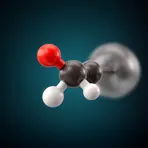
- Specialized
A carbon atom double-bonded to oxygen and single-bonded to hydrogen
- Specialized
A clear oily liquid made from two acetaldehyde molecules that has both alcohol and aldehyde parts

- Specialized
A sweet solid made when sugars break down in cells or lab reactions
Surface Forms
Etymology
Aldehyde comes from a shortened form of 'alcohol dehydrogenated', so think alcohol plus dehydrogenated, meaning 'an alcohol with hydrogen removed'. So an aldehyde is like an alcohol that has lost a hydrogen atom, which helps explain its special chemical group and why many aldehydes are very reactive and often have strong smells.