

afibrinogenemia
- noun
- /ˌeɪfaɪˌbrɪnədʒəˈniːmiə/
- Specialized
- The diagnosis of afibrinogenemia was confirmed by blood tests showing no detectable fibrinogen.
Examples
-
People with afibrinogenemia often require immediate medical treatment after even minor injuries.
-
Patients with afibrinogenemia often experience severe bleeding.
-
Because afibrinogenemia is inherited, genetic counseling was recommended for the patient's family.
-
The doctor diagnosed her with afibrinogenemia after extensive tests.
-
People with afibrinogenemia often need to take precautions to avoid injuries that could lead to bleeding.
-
The doctor explained that afibrinogenemia can lead to excessive bruising and prolonged bleeding in patients.
-
After sustaining a cut, the patient with afibrinogenemia needed immediate medical attention due to heavy bleeding.
Synonyms
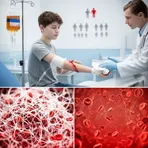
A rare inherited condition in which the blood has almost no fibrinogen, a protein needed for normal clotting
Compounds
- Specialized
A rare inherited condition in which the blood has almost no fibrinogen, a protein needed for normal clotting
Surface Forms
Morphology
afibrinogenemia = fibrinogenemia (opaque) = a + fibrinogen + emia
The term is formed by adding the medical privative prefix 'a-' to the technical compound 'fibrinogenemia'; the components are specialised medical morphemes unfamiliar to general learners.
Etymology
The word afibrinogenemia breaks into three parts: a- meaning 'not', fibrinogen the protein that helps blood form clots, and -emia meaning 'blood condition' like in anemia. So afibrinogenemia means the blood has no fibrinogen, which is why people with it can bleed for a long time.

