

fibrinogen


 1
8.5
1
8.5
- noun
- /faɪˈbrɪnədʒən/
- Specialized
- Concentrations of lipids, albumin, calcium, and phosphate in serum, and concentrations of fibrinogen and hemoglobin in plasma, were measured by standard methods in the clinical laboratory.
- fibrinogen concentration
- fibrinogen in plasma
- serum fibrinogen
Examples
-
OCs induce increases in factor VII coagulant activity and in fibrinogen concentrations, and lower antithrombin concentrations.
Academic text (1999) -
Thromboelastography also allows dynamic monitoring of thrombus formation and abnormal conditions in platelet function, fibrinogen, and fibrinolysis.
Academic text (2018) -
That converts fibrinogen to fibrin and as a result, coagulation occurs.
-
Factor Ha (thrombin) turns fibrinogen into fibrin, and factor Xa turns prothrombin into thrombin.
Academic text (2015) -
One component contains fibrinogen, aprotinin, and/or factor XIII, and the other is made up of human thrombin dissolved in a calcium chloride solution.
Academic text (2006) -
As a result, fibrinogen adsorbs and converts in situ to fibrin through a structural cleavage and eventually creates thrombosis.
Academic text (2018) -
Screening tests for hypercoagulability included normal levels of serum fibrinogen, d-dimers, protein C and S, antithrombin III, but positive antiphospholipid antibodies.
Academic text (2007) -
Moreover, significant differences have been encountered in acute phase response, and results showed a significant decrease in haptoglobin and fibrinogen in diseased newborn foals compared to controls.
Academic text (2014) -
Considering the relative concentration as well as specific biological properties, albumin, fibrinogen, and fibronectin are the most probable proteins for adsorption on the surface of a biomaterial in contact with blood.
Academic text (2018) -
Fibrinogen is essential for blood clotting because it transforms into fibrin when a wound occurs.
Synonyms
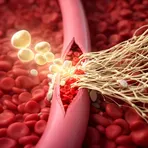
A blood protein that becomes fibrin to help stop bleeding
Surface Forms
Morphology
Etymology
Fibrinogen comes from fibrin, the same root as fiber, meaning 'thread', and the ending -gen, meaning 'to produce'. So fibrinogen is the protein in blood that produces the thread-like fibrin which helps form a clot to stop bleeding.