
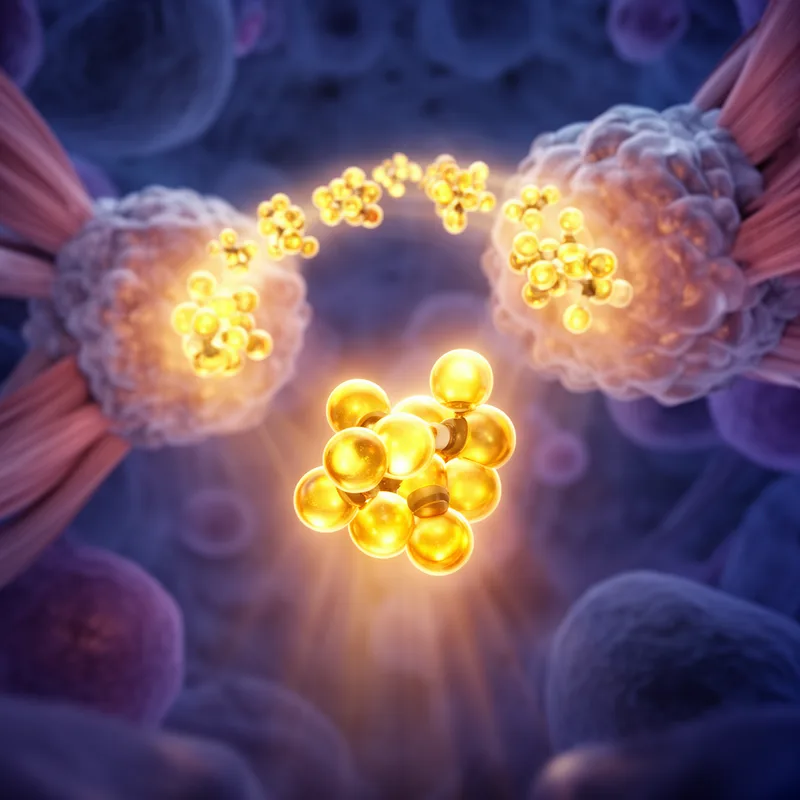
adenosine monophosphate
- noun
- /ˌædəˈnoʊsiːn ˌmɒnəˈfɔːsfeɪt/
- Specialized
- The body produces adenosine monophosphate during intense exercise.
Examples
-
What role does adenosine monophosphate play in muscle metabolism?
-
Muscles synthesize adenosine monophosphate during intense exercise to help restore energy balance.
-
Scientists analyzed the concentration of adenosine monophosphate in the tissue samples from laboratory animals.
-
When energy is required, adenosine monophosphate is converted into ADP and ATP in living cells.
-
Adenosine monophosphate is crucial for energy transfer in adenosine monophosphate muscle cells.
-
During intense exercise, adenosine monophosphate levels increase in the body.
-
In the biochemical pathway, adenosine monophosphate plays a key role in converting energy.
Synonyms

 11
6.8
11
6.8

A small chemical in muscle cells that helps make ATP for energy
A molecule in cells like muscle cells that helps store and release energy by changing into ADP and ATP
Surface Forms
Morphology
adenosine + monophosphate
The compound literally combines 'adenosine' + 'monophosphate' and thus denotes adenosine bearing a single (mono-) phosphate group, so its basic referent is compositionally derivable. However, the term uses specialized chemical morphemes and domain knowledge (what a phosphate group implies metabolically), so it is not immediately accessible to an average B1 learner even if they recognize the parts.
Etymology
Adenosine monophosphate is named from its parts: adenosine (a small molecule) and monophosphate meaning 'one phosphate'. Think of it as a tiny battery with only one power unit. Cells can change it into ADP or ATP to give or store energy, so the name points to a small molecule important for cellular energy.