

AMP
 11
6.8
11
6.8

- noun
- /eɪ ɛm pi/
- Specialized
- In muscle cells, AMP acts as a crucial signal for regulating metabolism.
- cyclic AMP
Loading YouTube…
Watch on YouTubeWe know the levels of ATP to ADP or AMP also play a role, and mitochondria are doing those things.
- We know the levels of ATP to ADP or AMP also play a role, and mitochondria are doing those things.
- So forsake of this discussion, IGF one is known to increase the growth of hair by extending that antigen phase as is cyclic AMP.
Examples
-
We know the levels of ATP to ADP or AMP also play a role, and mitochondria are doing those things.
-
So when you change that ratio, you activate a kinase called AMP kinase.
-
And this protein is the cyclic AMP regulatory protein.
-
The ratio in cells between AMP and ATP and ATP is energy.
-
The enzyme that does this conversion is is activated, and more cyclic AMP is released.
-
Mitochondria are producing ATP, but they also play a role in how much ADP and AMP are in the cell.
-
AMP manufactures the parts for these machines on conventional numerical-control (NC) mills and lathes.
Academic text (1996) -
The enzyme adenylate kinase converts ATP to AMP when energy levels are low.
-
AMP is formed when ATP loses one phosphate group during cellular processes.
Synonyms

A small molecule in cells that helps store and transfer energy
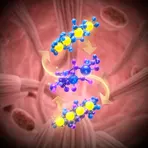
A molecule in cells like muscle cells that helps store and release energy by changing into ADP and ATP
Surface Forms
Morphology
AMP = A + M + P
AMP is an initialism (letters standing for a multiword technical term); the letters do not transparently convey the biochemical meaning to learners.
Etymology
AMP is short for adenosine monophosphate, a small molecule made of the base adenine, a sugar, and one phosphate group (the mono- part means 'one'). Because it can be changed into ADP and ATP, AMP is like a low-energy form that cells use to store and give out energy.