
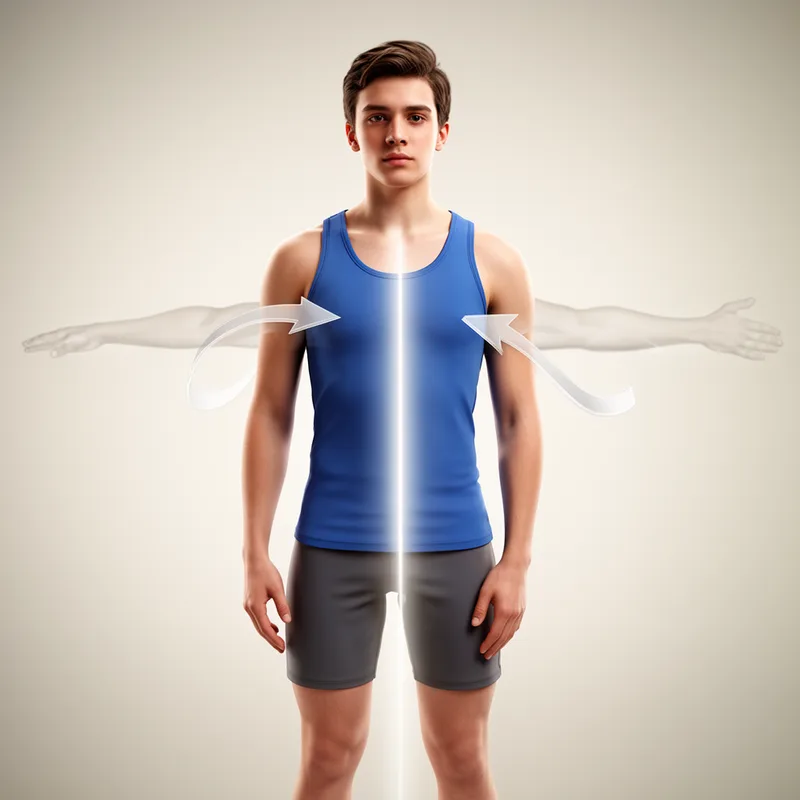
adduction
- noun
- /ædˈʌkʃən/
- Specialized
 :
aducción
:
aducción
- The physical therapist explained that adduction occurs when you bring your legs together.
- hip adduction
- degrees of adduction
- Vocal fold adduction
Examples
-
Hip abduction, adduction, external rotation, and hip flexion with the knee extended increased for both legs.
Academic text (1999) -
The diagnosis was based on a laryngoscopic examination that demonstrated a partial anterior adduction of the vocal folds on inspiration and a posterior diamond-shaped glottic gap.
Academic text (2009) -
Also, the hip was in greater adduction at foot contact following training.
Academic text (1999) -
Vocal fold adduction remained constant for all trials.
Academic text (2012) -
No horizontal adduction of the humerus occurs before front facing.
Academic text (1997) -
The forefoot adduction and hindfoot varus arc corrected before starting any correction of the heel cord equinus.
Academic text (2005) -
The ankle position at foot contact without stimulation was -5 degrees plantar flexion, -2 degrees adduction, and 4 degrees internal rotation, which corresponded to the initial POA in Figure 2 (dotted line).
Academic text (1992) -
During the exercise, the therapist guided me through an adduction of my arm towards my body.
-
In anatomical terms, adduction is the movement that decreases the angle between a limb and the body.
Synonyms

 1
9.9
1
9.9

A movement that brings a body part toward the middle of the body
Antonyms

Surface Forms
Morphology
Etymology
Adduction comes from the Latin parts ad- meaning 'to' or 'toward' and ducere meaning 'to lead', the same root you see in words like conduct and duct. So adduction is the 'leading' of a limb toward the middle of the body, which is why it means moving a body part inward.