

Zoomastigina
- noun
- /ˌzoʊməˈstɪdʒɪnə/
- Archaic
- Zoomastigina were once classified as a separate phylum in older biology textbooks.
Examples
-
The organisms in Zoomastigina move using one or more flagella.
-
The Zoomastigina were once classified as a distinct group of protists.
-
Modern classification has replaced Zoomastigina with more precise protozoan groupings.
-
The classification of Zoomastigina has changed over the years.
-
Zoomastigina were once recognized as a separate group of flagellated protists in earlier biological studies.
-
In ancient taxonomy, Zoomastigina encompassed various flagellate organisms that are now reclassified.
-
Textbooks of the past included Zoomastigina to describe certain single-celled, animal-like protists.
Synonyms

Single-celled living things that move using one or more whip-like tails

One-celled living things that move using one or more whip-like tails
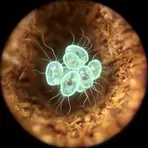
A group of tiny single-celled organisms with tail-like flagella that often live as parasites
Surface Forms
Morphology
Zoomastigina = zoo + mastig + ina
Although 'zoo' is recognizable, the combining form 'mastig' and the taxonomic suffix '-ina' are specialized classical/technical elements unfamiliar to average learners, so the meaning cannot be reliably derived from the parts.
Etymology
Zoomastigina comes from Greek parts zoo- 'animal' and mastig- 'whip', and you can remember zoo- because it is the same as the English word zoo. It was used for single-celled, animal-like organisms that move with whip-like tails called flagella, so the name helps you remember their 'animal' nature and how they swim, though this group name is no longer used in modern biology.

