
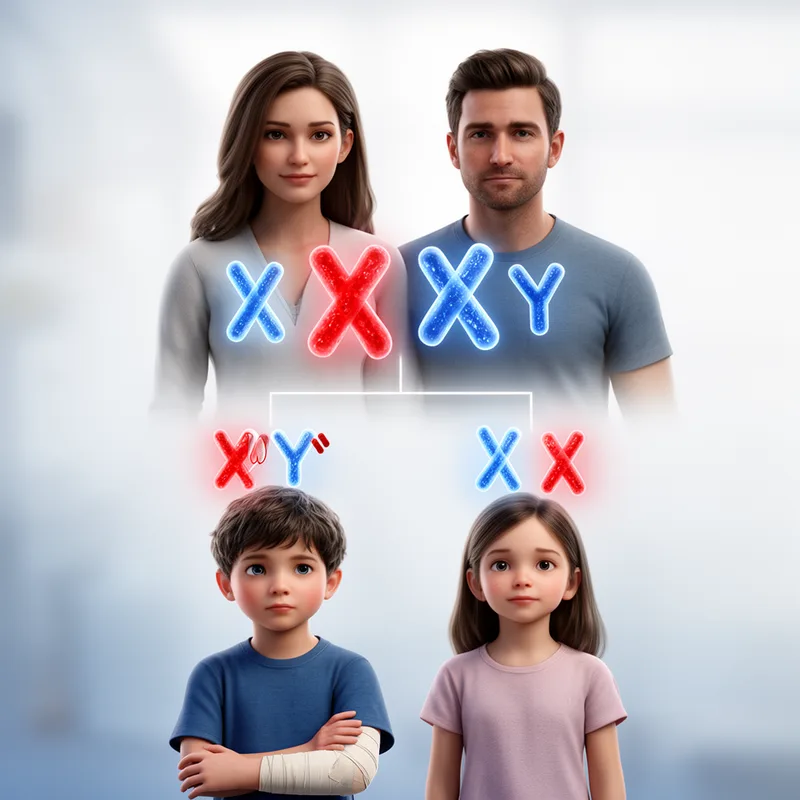
X-linked recessive inheritance
- noun
- /ɛks lɪŋkt rɪˈsɛsɪv ɪnˈhɛrɪtəns/
- Specialized
- Many genetic disorders, such as hemophilia, are inherited through X-linked recessive inheritance.
Examples
-
In X-linked recessive inheritance, males are more likely to express the trait than females.
-
A family history may help reveal if a condition follows an X-linked recessive inheritance pattern.
-
The study focused on X-linked recessive inheritance in genetic disorders.
-
Can you explain X-linked recessive inheritance to me?
-
Many genetic disorders, such as hemophilia, are inherited through X-linked recessive inheritance.
-
In X-linked recessive inheritance, males are more likely to express the trait than females.
-
A family history may help reveal if a condition follows an X-linked recessive inheritance pattern.
Surface Forms
Morphology
X-linked + recessive + inheritance
The meaning is fully compositional: 'X-linked' (on the X chromosome) + 'recessive' (a recessive gene effect) + 'inheritance' (transmission across generations) directly describe a hereditary pattern where a recessive gene on the X chromosome is passed on. Although technical, there is no idiomatic shift — a learner who understands the constituent terms (and basic sex-chromosome genetics) can infer the MWE's meaning.
Etymology
X-linked recessive inheritance describes a simple picture: a faulty gene sits on the X sex chromosome so it is X-linked, and the fault is recessive, meaning it only 'shows' when there is no healthy copy to hide it. Because males have only one X while females have two, the fault more often 'shows' in males and females can 'carry' it without 'showing' it.

