

Western honey mesquite
- noun
- /ˈwɛstərn ˈhʌni mɛsˈkiːt/
- US
- The Western honey mesquite thrives in arid regions thanks to its deep roots and drought resistance.
Examples
-
Farmers rely on the pods of Western honey mesquite as a nutritious feed for their cattle.
-
Efforts to control Western honey mesquite are ongoing, as it often forms dense thickets on rangelands.
-
The Western honey mesquite thrives in arid conditions.
-
Farmers often plant Western honey mesquite for its drought resistance.
-
Farmers rely on the pods of Western honey mesquite as a nutritious feed for their cattle.
-
Efforts to control Western honey mesquite are ongoing, as it often forms dense thickets on rangelands.
-
The Western honey mesquite thrives in arid regions thanks to its deep roots and drought resistance.
Synonyms
 8
8.7
8
8.7

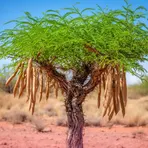
A small thorny tree or bush from dry land with sweet seed pods
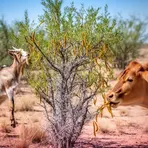
A thorny shrub from dry parts of North America that has sweet pods eaten by farm animals

A thorny small tree with deep roots that makes sweet pods eaten by farm animals
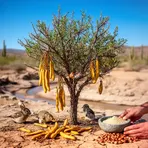
A small spiny tree that grows in dry places and makes sweet pods
Surface Forms
Morphology
The phrase is a straightforward compositional noun phrase: 'honey mesquite' describes a mesquite (a tree/shrub) characterized by sweet, honey-like pods and 'western' simply marks its regional variety. A B1 learner who knows 'western', 'honey', and 'mesquite' can directly infer this botanical meaning from the constituents.
Etymology
Western honey mesquite gets its name from what people noticed: Western because it grows in the dry American West, honey because its long seed pods are very sweet like 'honey', and mesquite from the Spanish name for the shrub. So the name tells you it is a thorny western tree with sweet pods people used as 'feed' for animals.