
Prosopis glandulosa
- noun
- /prəˈsoʊpɪs ɡlænˈdʒuːloʊsə/
- Specialized
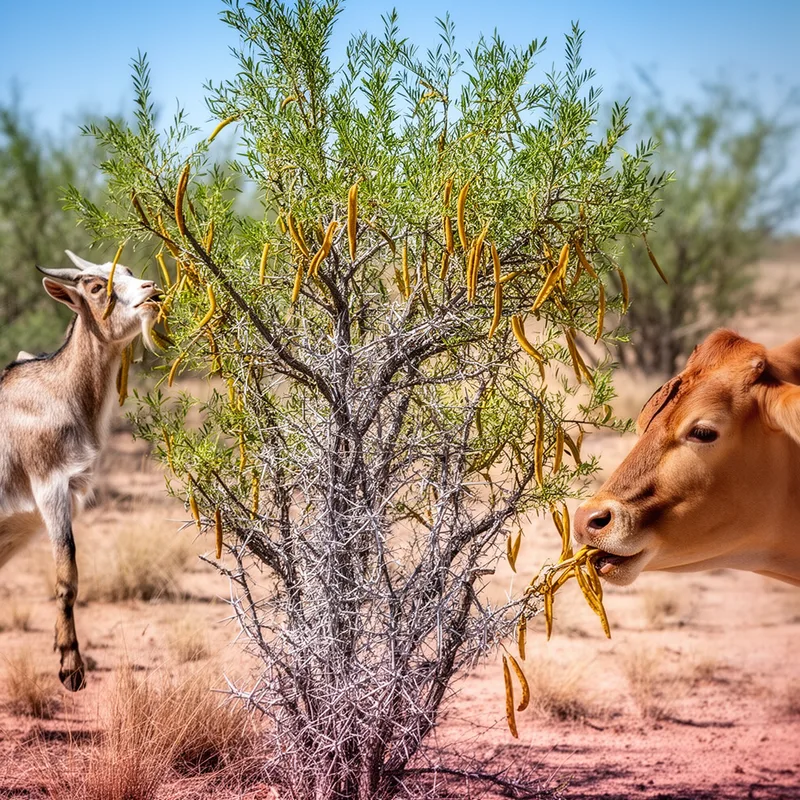
- The Prosopis glandulosa produces sweet pods that are a vital food source for livestock.
Examples
-
The Prosopis glandulosa provides essential food for livestock in arid regions.
-
Thickets of Prosopis glandulosa can quickly dominate grasslands if not managed.
-
Researchers are studying the drought resistance of Prosopis glandulosa for habitat restoration projects.
-
The Prosopis glandulosa thrives in arid conditions.
-
Farmers often plant Prosopis glandulosa for its drought resistance.
-
In the desert landscape, the Prosopis glandulosa stands out for its resilience to drought.
-
Farmers in the southwestern United States value Prosopis glandulosa as a drought-resistant crop.
Synonyms

A thorny small tree with deep roots that makes sweet pods eaten by farm animals

A thorny small tree with deep roots that grows in dry areas and has sweet pods used as animal feed
Surface Forms
Morphology
Prosopis + glandulosa
This is a Latin binomial (scientific name) functioning as a species label rather than a compositional phrase whose meaning a B1 learner could infer from parts. Even if a learner recognized 'Prosopis' as a plant genus, the element 'glandulosa' is not a common English word and the name does not transparently convey the everyday properties (honey mesquite, drought resistance), so the overall meaning is not derivable from the constituents.
Etymology
Prosopis glandulosa comes from the common shrub called 'honey mesquite', a thorny bush with deep roots and sweet, honey-like seed pods that animals eat. That's why the name refers to a tough shrub that lives in dry places and provides important food for livestock.

