

honey mesquite
- noun
- /ˈhʌni mɛsˈkiːt/
- US
- The honey mesquite thrives in arid regions, providing both shade and food for grazing animals.
Examples
-
Farmers often use honey mesquite pods as a nutritious supplement for their cattle.
-
Dense thickets of honey mesquite can be challenging to clear from pastureland.
-
The honey mesquite tree provides shade in the hot desert.
-
Many ranchers use honey mesquites as a natural barrier.
-
Farmers often use honey mesquite pods as a nutritious supplement for their cattle.
-
Dense thickets of honey mesquite can be challenging to clear from pastureland.
-
The honey mesquite thrives in arid regions, providing both shade and food for grazing animals.
Synonyms
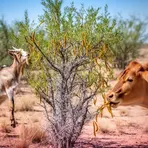
A thorny shrub from dry parts of North America that has sweet pods eaten by farm animals

A thorny small tree with deep roots that grows in dry areas and has sweet pods used as animal feed
Surface Forms
Morphology
This is a straightforward nominal compound where 'mesquite' names the shrub/tree and 'honey' qualifies it as having honey-like qualities (sweet pods or a honey-related color/variety). A B1 learner who knows both constituents can readily infer it refers to a type/variety of mesquite associated with honey-like sweetness or color, so the meaning is compositionally transparent.
Etymology
The plant honey mesquite is a thorny shrub or small tree whose name paints a picture: it makes long, sweet seed pods that taste like honey, and mesquite is the shrub itself. Farmers and grazing animals ate those sweet pods as 'feed', and the plant's deep roots and thorny clumps explain why the name refers to a dense, hard-to-clear bush.

