
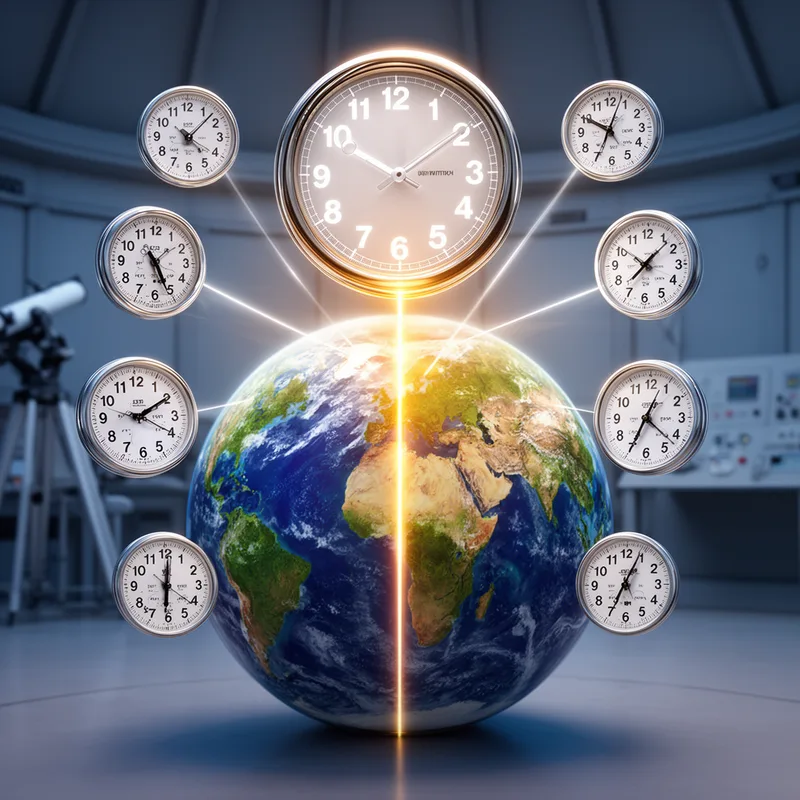
Universal Time
 1
4.8
1
4.8

- noun
- /ˈjuːnɪvɜrsəl taɪm/
- Specialized
- By calculating both the time of the beginning and end of twilight and the time of rise and set of the comet, we can deduce the Universal Time of the observation to within a few hours.
- Universal Time (UT)
Examples
-
Please convert the meeting time to Universal Time so everyone can join regardless of their location.
-
After all, before the locomotive age, "universal time" did not even exist; time was location specific and set according to solar readings.
Academic text (2004) -
Meteor counts could rise to 100 per hour around 4:45 Universal Time, which would favor observers in Europe and Africa.
Academic text (2006) -
The burst should occur at 20:54 Universal Time on August 11, which favors observers in Europe and Asia.
Academic text (2004) -
Sometimes these are easily correctable, commonly by changing the observation time by one day; observers frequently confuse the dates when they convert to Universal Time.
Academic text (1996) -
To remove the effects of the different time zones on Earth, astronomers use Universal Time, which is the same as Greenwich Mean Time, to refer to the time astronomical events occur. -- Ed.
Academic text (1992) -
Oppolzer recorded this eclipse as having reached the midpoint of its totality at 1:10 Universal Time, or at 1:10 a.m. on the morning of 30 June 763.
Academic text (1992) -
The Global Positioning System, see "Relativity in the Palm of Your Hand," May/June, p. 23, provides timing accuracy of about 10 milliseconds for each measurement, allowing observers to determine the time of an eclipse to within 2 seconds in Universal Time.
Academic text (1996) -
The event is scheduled to start at 15:00 Universal Time on Tuesday.
-
Astronomers base their observations on data recorded in Universal Time to ensure consistency.
Synonyms
 62
4.0
62
4.0
The global time standard used to keep clocks the same everywhere
 12
4.7
12
4.7
A time at zero longitude in Greenwich, England used as the world time reference
 1
3.7
1
3.7
People use the time at Greenwich in England as the world time standard


 1
3.4
1
3.4
Time at Greenwich, England that is used worldwide as the standard
Time at Greenwich, England used as the world standard

The global time for clocks, based on Greenwich time and adjusted with extra seconds to match Earth's rotation

A precise time based on the Earth's rotation measured at Greenwich used for astronomy and navigation

Time kept by an imaginary sun moving at a steady speed used for standard clocks
Surface Forms
Morphology
The core meaning — a time standard that applies everywhere — follows directly from combining 'universal' (applicable in all places) with 'time' (measurement of moments), so a B1 learner who knows both words will grasp the basic concept. Technical details (mean solar time, Prime Meridian) are specialized knowledge, but they do not prevent the MWE from being compositionally transparent and cross-linguistically recognizable.
Etymology
Universal Time comes from the idea of using one fixed clock in Greenwich, England, so everyone could set their watches to the same universal time. That's why Universal Time means 'one standard time used around the world'.